Cubic Yards of Fill Dirt Calculator for Yard Leveling
Precision earthwork estimation. Input in Feet, Meters, or Yards. Get exact Cubic Yardage.
By Todd Bly, B.S. Construction Management · Updated October 2026
Pro Fill Dirt Calculator
Accurate estimates for Yards, Tons, & Compaction
Results
How to Calculate Cubic Yards of Fill Dirt Calculator for Yard Leveling
The Formula
To calculate yards of dirt, multiply the coverage area (sq ft) by the depth (ft) to get Cubic Feet, then divide by 27 to convert to Cubic Yards. Our tool handles Metric (Meters) and Imperial (Feet) inputs automatically.
Measure Accurately
Measure in feet. For depth, measure in inches and our tool handles the conversion (divide by 12).
Check Your Shape
Most cubic yards of fill dirt calculator for yard leveling projects are areas. If irregular, break it into smaller shapes.
Add Compaction
Guessing yardage leads to shortages. Our fill dirt yardage calculator uses specific density formulas and multi-unit support to tell you exactly how many yards of fill dirt you need.
📖 Table of Contents
Calculate Yards of Fill Dirt: The Complete Guide
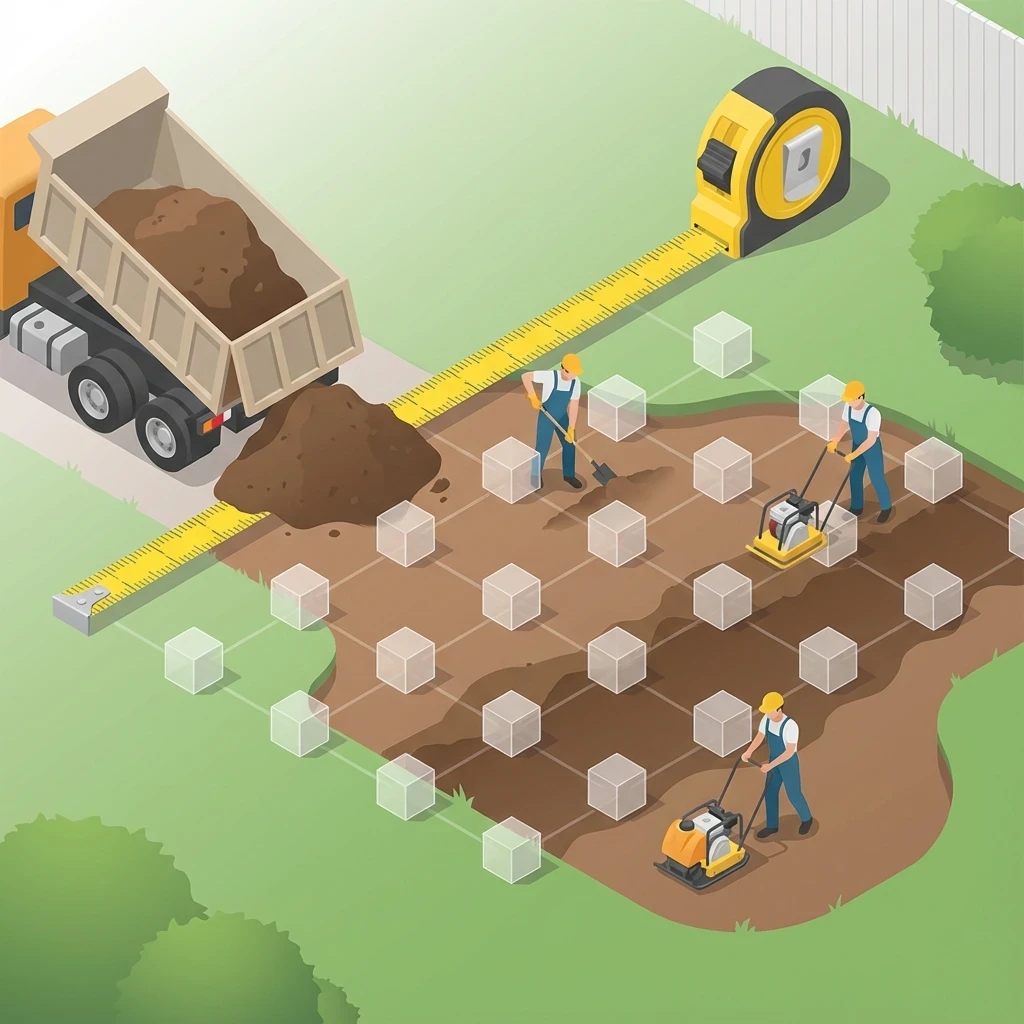
Ever stood in your backyard staring at that bumpy, uneven patch of ground and thought, "How do I calculate yards of fill dirt needed for this mess?" You're definitely not alone! This exact question keeps thousands of homeowners and contractors up at night.
And here's the brutal truth: Getting your fill dirt calculation wrong can cost you hundreds or even thousands of dollars. Order too little, and you're stuck paying for a second delivery (ka-ching! Another $150-$200 gone). Order too much, and you've got a massive dirt mountain in your driveway that your neighbors will absolutely complain about.
The $500 Mistake Story
My neighbor Tom decided to "eyeball" his 20×30 foot yard leveling project. He figured he needed about 8 cubic yards. Seemed reasonable, right? But when he actually used a fill dirt calculator yards tool to calculate fill dirt cubic yard measurements properly (factoring in that 6-inch depth AND compaction), he actually needed 14 yards! His "small" miscalculation meant scrambling for a second delivery mid-project. Total penalty: $375 in extra fees plus a week of embarrassment.
But don't panic! In this comprehensive guide, I'm going to show you exactly how to calculate cubic yards of fill dirt like a seasoned professional. We'll cover everything from basic formulas to advanced techniques, common pitfalls to avoid, and how to use both manual calculations and modern fill dirt yardage calculator tools.
Whether you're a first-time DIYer tackling yard leveling or a contractor prepping a foundation, by the end of this guide you'll be ordering fill dirt with complete confidence. Let's dive in!
What is Fill Dirt? (And Why Do You Actually Need It?)
Let's start with the absolute basics before we get into how to calculate yards of fill dirt. Fill dirt is essentially the unsung hero of construction and landscaping – it's not the glamorous topsoil that makes your garden grow. Think of it as the structural backbone, the skeleton beneath your project's skin.
Unlike topsoil (which is loaded with organic matter like decomposed leaves and is perfect for plants), fill dirt is typically composed of subsoil – that's the layer way beneath the topsoil. It contains clay, sand, and broken-down rocks with minimal organic content. This composition makes it absolutely perfect for compacting into a stable foundation that won't shift dramatically or create sinkholes over time.
Foundation Stability
Creating solid, compactable bases for buildings, patios, and driveways that won't shift or settle excessively over the years.
Leveling & Grading
Fixing those annoying bumps and dips in your yard that make mowing a total nightmare and create water pooling problems after every rain.
Drainage Solutions
Raising grades around your home to direct water AWAY from your foundation (and out of your basement – goodbye flooding!).
Common Fill Dirt Projects:
- •Yard leveling to fix bumpy, uneven lawns
- •Building up areas for patios, driveways, or walkways
- •Foundation preparation for new construction or additions
- •Retaining wall backfill to prevent erosion and provide support
- •Creating raised garden beds or landscaping features
But here's the million-dollar question that everyone asks when they start any of these projects: How many yards of fill dirt do I actually need? That's exactly what our online calculate fill dirt cubic yard tool helps you figure out accurately!
💡 Quick Fact
The average residential yard leveling project requires anywhere from 5-30 cubic yards of fill dirt. Getting your calculation right when you calculate yards of fill dirt needed can save you $200-$500 in wasted material and delivery costs!
Why Accurate Calculation Matters (It's All About Your Money!)
Okay, so calculating yards of fill dirt needed isn't just about being mathematically precise for the sake of it. Let me paint you a vivid picture of what can go terribly wrong when you wing it...
Under-Ordering = $$$ Pain
This is actually WORSE than over-ordering. Here's why:
- •Second delivery fee: $100-$200 (ouch!)
- •Labor standing around waiting: $50-$100/hour
- •Project delays: Your timeline gets destroyed
- •Stress and embarrassment: Priceless
Over-Ordering = Waste
Having too much creates its own problems:
- •Disposal/removal costs: $20-$40/yard
- •Wasted material money: $10-$50/yard
- •Storage nightmares: Where does that dirt mountain go?
- •HOA complaints: Your neighbors won't be happy!
💡 The Smart Professional Approach
Here's what the pros do: They use reliable fill dirt yard calculator tools, measure twice (or three times!), do the math to properly calculate cubic yards of fill dirt, and typically add a 10-15% safety buffer.
Why? Because that $100-150 worth of "extra" dirt sitting in a small pile is WAY cheaper than a $300+ penalty for a second delivery! It's not about being perfect – it's about being smart with your money and avoiding costly mistakes. For detailed cost estimates, use our fill dirt cost calculator.
Real-World Example of the Cost Impact
Let's say you've got a 20×30 foot area with an average 6-inch dip that needs filling. Quick mental guess? Maybe 8-10 cubic yards seems reasonable.
But when you properly calculate fill dirt needed using the correct formula (we'll cover this in the next section) AND factor in 20% compaction, you actually need 13-15 yards!
That "small" 3-5 yard miscalculation = $150-$400 mistake depending on your location and supplier pricing!
That's precisely why knowing how to calculate fill dirt for yard projects accurately isn't optional – it's absolutely essential to your budget!
How to Calculate Yards of Fill Dirt: Step-by-Step Guide
Alright, let's roll up our sleeves and dive into the actual math! Don't worry – I promise to make this as painless as possible. Think of calculating cubic yards of fill dirt like following a recipe. Get the steps right, and you'll get perfect results every single time!
Essential Measurement Tools You'll Need
Before you can calculate fill dirt for yard projects accurately, you need the right tools. Here's your essential toolkit:
Tape Measure (50-100ft)
Your workhorse for accurate linear measurements. Get a good quality one that's at least 50 feet long for most residential projects. Don't even think about pacing it out with your feet – that's a recipe for disaster!
Laser Level or String Level
Crucial for determining depth accurately across large areas. Laser levels are more precise and easier to use, but string levels work too for smaller projects!
Calculator or Smartphone
Unless you're a math genius, you'll need a calculator. Better yet, use our free cubic yard calculator fill dirt tool at the top of this page!
📝 Pro Tip: Write Everything Down!
Grab a notepad and pencil. Write down EVERY measurement as you go. You'll think "Oh, I'll remember that the north side was 23.5 feet"... and then you absolutely won't. Trust me on this!
The Basic Formulas (It's Easier Than You Think!)
Here's the core formula that every fill dirt cubic yard calculator uses. This is what you need to know about how to calculate cubic yards of fill dirt:
(Length × Width × Depth) ÷ 27 = Cubic YardsWhy divide by 27? Because 1 cubic yard = 3ft × 3ft × 3ft = 27 cubic feet!
CRITICAL Rule: Always Use the Same Units!
This seems obvious, but it's the #1 mistake people make when trying to calculate yards of fill dirt. If you measure length and width in feet, you MUST measure depth in feet too!
⚠️ Common Mistake:
Measuring length/width in feet but depth in inches, then wondering why the math is completely wrong!
Quick Unit Conversions
Inches to Feet:
- • 1 inch = 0.083 feet
- • 2 inches = 0.167 feet
- • 3 inches = 0.25 feet
- • 4 inches = 0.33 feet
- • 6 inches = 0.5 feet
- • 8 inches = 0.67 feet
- • 12 inches = 1 foot
Cubic Feet to Cubic Yards:
- • 27 cubic feet = 1 cubic yard
- • 81 cubic feet = 3 cubic yards
- • 135 cubic feet = 5 cubic yards
- • 270 cubic feet = 10 cubic yards
- • 405 cubic feet = 15 cubic yards
- • 540 cubic feet = 20 cubic yards
Calculating Different Shapes: Rectangles, Circles, and Slopes
Rectangular Areas (Most Common)
Rectangles are the easiest to calculate yards of fill dirt for. You need three measurements: Length, Width, and Depth (all in feet).
📏 Rectangle Example
You're filling a flower bed that's 20 feet long, 10 feet wide, and you need 6 inches (0.5 feet) of fill dirt.
Step 1: Calculate volume = 20 × 10 × 0.5 = 100 cubic feet
Step 2: Convert to yards = 100 ÷ 27 = 3.7 cubic yards
Step 3: Add 20% compaction = 3.7 × 1.20 = 4.4 cubic yards
Order: 4.5-5 cubic yards (always round up!)
Circular Areas (Ponds, Round Patios)
For circular projects, the formula changes slightly. You need the Diameter (distance across) or Radius (half the diameter), plus Depth.
Circle Formula:
π × (Radius²) × Depth ÷ 27 = Cubic YardsFor π (pi), just use 3.14 unless you're building something for NASA!
⭕ Circle Example
You're filling a circular pond that's 12 feet across (diameter) and needs 2 feet of fill.
Step 1: Find radius = 12 ÷ 2 = 6 feet
Step 2: Calculate volume = 3.14 × (6²) × 2 = 3.14 × 36 × 2 = 226 cubic feet
Step 3: Convert to yards = 226 ÷ 27 = 8.4 cubic yards
Step 4: Add compaction = 8.4 × 1.15 = 9.7 cubic yards
Order: 10 cubic yards
Sloped or Wedge-Shaped Areas (Ramps, Grading)
This is where many people struggle with how to calculate fill dirt yards. For slopes, the volume is actually HALF that of a rectangle!
Slope/Wedge Formula:
(Length × Width × Average Depth) ÷ 2 ÷ 27 = Cubic YardsAverage Depth = (Deepest Point + Shallowest Point) ÷ 2
🔺 Slope Example
You're filling a driveway approach. At the street, you need 12 inches (1 ft) of fill. At the garage, 0 inches. The area is 15 feet long by 10 feet wide.
Step 1: Average depth = (1 + 0) ÷ 2 = 0.5 feet
Step 2: Volume = (15 × 10 × 0.5) ÷ 2 = 75 ÷ 2 = 37.5 cubic feet
Step 3: Convert = 37.5 ÷ 27 = 1.4 cubic yards
Step 4: Add compaction = 1.4 × 1.20 = 1.7 cubic yards
Order: 2 cubic yards
🎯 Quick Reference: When to Use Which Formula
- ▪Rectangle/Square: L × W × D ÷ 27
- ▪Circle: 3.14 × R² × D ÷ 27
- ▪Slope/Wedge: (L × W × Avg D) ÷ 2 ÷ 27
- ▪Irregular: Break into smaller shapes, calculate each, then add together!
Fill Dirt Calculator Yards Tools: Online vs Manual
You might be thinking, "If I can use a fill dirt calculator yards tool, why bother learning all this math?" Great question! Let me break down when to use each approach and why understanding both matters.
✅ Benefits of Online Calculators
- •Lightning Speed: Get results in seconds vs. 10 minutes of manual math
- •Auto Compaction: Automatically adds 15-30% compaction factor
- •Multi-Unit Support: Switch between feet, inches, meters effortlessly
- •Error-Free: No decimal mistakes or division errors
- •Shape Support: Handles rectangles, circles, slopes, wedges
📏 When Manual Makes Sense
- •You're on-site without internet access
- •You want to double-check calculator results
- •Making quick rough estimates for planning
- •You enjoy math (hey, some people do!)
- •Teaching others how the calculation works
💡 Pro Recommendation
Use our online calculate fill dirt cubic yard tool at the top of this page for your primary calculation. It's free, fast, and accurate. Then, if you want extra confidence, do a quick manual calculation to verify. This double-check approach is what professional contractors use!
Remember: Always round UP when ordering. Better to have half a cubic yard extra than to be short!
The Compaction Factor: Why You Need More Than You Think
Here's where a LOT of people mess up when they calculate cubic yards of fill dirt, and it can cost them big time. You've done all the measurements perfectly, calculated your volume, feeling pretty good about yourself... and then someone asks, "Did you account for compaction?"
If your answer is "Wait, what??" – keep reading. This section will save you hundreds of dollars!
What is Soil Compaction? (The Potato Chip Analogy)
When fill dirt gets delivered to your site, it's loose and fluffy – absolutely full of air pockets. Here's my favorite analogy: Think of a bag of potato chips.
🥔 The Potato Chip Effect
When you first open a family-size bag of chips, it's all puffy and full – looks like you got a lot! But then you shake the bag, or someone sits on it, and suddenly that same amount of chips takes up half the space. That's EXACTLY what happens with fill dirt!
Compaction is the process of pressing fill dirt particles closer together, removing air pockets, and creating denser, more stable material. This happens through mechanical compaction (equipment), natural settling (gravity + moisture), and load-bearing (weight of whatever you build on top).
Why This Matters for Your Calculation
That fluffy, loose dirt arriving on the truck is going to compact down by 10-30% depending on soil type and how much you compact it. If you calculated you need 10 cubic yards to fill a space and don't account for compaction, you might end up with only 7-8 yards of compacted material after it settles!
⚠️ Real Horror Story
A contractor friend calculated he needed exactly 20 yards for a patio base. He was confident in his math – length × width × depth ÷ 27 = 20 yards. Perfect!
He ordered 20 yards. Spread it. Compacted it. And ended up 3-4 yards SHORT because he forgot the compaction factor. That mistake cost him $400+ in extra delivery fees and a very unhappy client waiting an additional week!
Standard Compaction Percentages by Project Type
So how much should you add when you calculate fill dirt needed? It depends on your project and how critical stability is:
Light Projects
Add 10-15% for:
- • Raised garden beds
- • Landscaping berms
- • Filling small depressions
- • Light foot traffic areas
- • Decorative features
Multiply result by 1.10 to 1.15
Medium Projects
Add 15-20% for:
- • Yard leveling (most common)
- • Pathways and walkways
- • Shed foundations
- • Pool bases
- • Residential driveways
Multiply result by 1.15 to 1.20
Heavy Projects
Add 20-30% for:
- • Building foundations
- • Retaining wall backfill
- • Commercial driveways
- • Heavy vehicle areas
- • Structural/engineered fill
Multiply result by 1.20 to 1.30. See our compaction calculator for more details.
Compaction Comparison Example
Let's say your base calculation shows you need 10 cubic yards. Here's how compaction affects your actual order:
- With 10% compaction:11 cubic yards
- With 15% compaction:11.5 cubic yards
- With 20% compaction:12 cubic yards
- With 30% compaction:13 cubic yards
💰 Cost Impact
That's a 3-cubic-yard swing between light and heavy compaction!
At typical pricing, that's a $150-$300 difference. But remember: under-ordering and needing a second delivery costs way more than over-ordering by a yard or two!
Converting Cubic Yards to Tons (Weight vs Volume)
Here's something that confuses even experienced folks: fill dirt is sold two different ways – by volume (cubic yards) or by weight (tons). Your yards of fill dirt calculator gives you cubic yards, but what if your supplier quotes by the ton? Use our tons calculator for easy conversion.
Weight Variations by Soil Type
The standard conversion is approximately 1.3 tons per cubic yard for typical fill dirt. But – and this is a BIG but – that number varies wildly depending on composition and moisture!
| Soil Type | Dry (tons/yard) | Wet (tons/yard) |
|---|---|---|
| Clean Fill Dirt | 1.2 - 1.4 | 1.5 - 1.6 |
| Clay-Heavy Fill | 1.4 - 1.6 | 1.7 - 1.8 |
| Sandy Fill | 1.2 - 1.35 | 1.4 - 1.5 |
| Mixed/Unscreened | 1.3 - 1.7 | 1.6 - 2.0 |
Weight Warning!
Water is HEAVY! When fill dirt absorbs rain or groundwater, its weight increases by 30-40%. Clay-heavy fill can go from 1.4 tons/yard dry to 1.8 tons/yard wet!
If you order 10 cubic yards of wet, clay-heavy fill (1.7 tons/yard), that's 17 tons = 34,000 pounds arriving on your driveway! Make sure your driveway can handle that load.
Conversion Formulas
Cubic Yards to Tons:
Example: 10 yards × 1.3 tons/yard = 13 tons
Tons to Cubic Yards:
Example: 15 tons ÷ 1.3 = 11.5 yards
Common Fill Dirt Projects and Calculations
Yard Leveling and Grading (Most Popular Project)
Got a lumpy yard that makes mowing a nightmare? Water pooling after every rain? You need to calculate fill dirt for yard leveling properly. The trick is figuring out your average depth across the uneven area.
📏 The "Average Depth" Method
Don't just measure the deepest hole! Here's the smart approach:
- 1. Measure depth at 5-8 different points across the low area
- 2. Add all measurements together
- 3. Divide by the number of measurements
- 4. Use this average depth in your calculation
Driveway and Patio Base Calculations
Before laying pavers or pouring concrete, you need a stable, level base. For a typical 12×12 patio with a 4-inch (0.33 ft) base:
Calculation: 12 × 12 × 0.33 = 47.5 cubic feet
Convert: 47.5 ÷ 27 = 1.76 cubic yards
Add 20% compaction: 1.76 × 1.20 = 2.1 cubic yards
Order: 2.5 cubic yards
Foundation and Construction Fill
Building an addition or new garage? Foundation work requires heavy compaction (25-30%). This is NOT the place to skimp!
Most foundation projects require engineered fill with specific compaction standards and building department inspection. Don't DIY this unless you really know what you're doing!
❌ Common Mistakes When Calculating Fill Dirt Cubic Yard
Mistake #1: Unit Conversion Errors
This seems simple but causes SO many problems. Mixing feet and inches in calculations is like mixing up left and right turns!
💣 Actual Horror Story:
Someone measures a driveway: 50 feet long, 12 feet wide, 4 inches deep.
Wrong calculation: 50 × 12 × 4 = 2,400 ÷ 27 = 89 yards (DISASTER!)
Correct calculation: 50 × 12 × 0.33 feet (4 inches) = 198 ÷ 27 = 7.3 yards
That's ordering 12× more dirt due to a unit error!
Mistake #2: Forgetting Compaction
The #1 mistake when people calculate yards of fill dirt needed! Fill WILL compact. It WILL settle. Don't skip this step or you'll run short!
Mistake #3: Not Breaking Down Irregular Shapes
Don't try to calculate a weird L-shaped area as one big irregular shape. Break it into smaller rectangles, calculate each separately, then add them up. Way more accurate!
✅ The Smart Approach
- • Use a reliable fill dirt cubic yard calculator
- • Measure twice (or three times!)
- • Always use the same units
- • Add appropriate compaction percentage
- • Round UP when ordering
- • Add a 10-15% safety buffer
💰 Cost Considerations for Fill Dirt Projects
Average Fill Dirt Prices per Cubic Yard
Fill dirt costs vary significantly by location and quality. Here's what you can expect to pay:
Material Cost
per cubic yard depending on quality and location
Delivery Fee
per trip (higher for remote areas)
Equipment Rental
per day for plate compactor
💡 Money-Saving Tips
- •For deep fills (>12 inches), use cheaper unscreened fill for bottom layers, then top with 6 inches of clean screened fill
- •Get quotes from multiple suppliers – prices can vary by 30-50%!
- •Time your project for off-season (late fall/winter) for potential discounts
- •Split delivery costs with neighbors doing similar projects
🎯 Professional Tips for Calculating Cubic Yards of Fill Dirt
The 10-15% Buffer Rule
Professional contractors ALWAYS add extra. If your fill dirt yard calculator says 10 yards, order 11-12 yards minimum.
Small extra pile? Find a use for it. Running short mid-project? Disaster and major expense.
When to Hire a Pro
For projects >50 cubic yards, foundations, or anything requiring building permits, hire a professional engineer or contractor.
DIY yard leveling? Go for it. DIY foundation fill? Call a pro – it's worth it!
Earthwork Terminology Every DIYer Should Know
Bank vs. Loose vs. Compacted
Bank Cubic Yards (BCY): Dirt in the ground (undisturbed)
Loose Cubic Yards (LCY): Dirt dug up (fluffed/swelled)
Compacted Cubic Yards (CCY): Dirt rammed into place
Clean Fill vs. Dirty Fill
Clean fill contains only inorganic soil/rocks. "Dirty" fill may contain organic roots, trash, or debris that rot and cause future sinkholes. Always specify clean fill for important projects!
🌟Bonus Pro Secrets
- ✓Take photos of your measurements and write notes directly on the photos
- ✓Mark your project area with spray paint or stakes before ordering
- ✓Schedule delivery for when you have help available – dirt waits for no one!
- ✓Have your delivery area prepped and accessible for the truck
Conclusion: You're Now a Fill Dirt Calculation Expert!
Congratulations! You now know exactly how to calculate yards of fill dirt like a professional contractor. Let's recap the key points:
Essential Takeaways:
- ✓Use the formula: (Length × Width × Depth) ÷ 27 = Cubic Yards
- ✓Always use the same units (convert inches to feet!)
- ✓Add 10-30% for compaction depending on your project type
- ✓Use our free fill dirt calculator yards tool for instant, accurate results
- ✓Round UP when ordering and add a 10-15% safety buffer
Whether you're tackling a simple yard leveling project or preparing for major construction, accurate calculation is the difference between a smooth, budget-friendly project and a costly nightmare of delays and extra deliveries.
Remember: It's not about being perfect – it's about being smart! Use reliable tools, measure carefully, account for compaction, and always err on the side of ordering slightly more rather than running short. That extra half-yard of dirt is WAY cheaper than a second delivery fee!
Ready to Calculate Your Fill Dirt Needs?
Use our free online calculate fill dirt cubic yard tool at the top of this page to get instant, accurate results for your project. No signup required, completely free, and trusted by thousands of DIYers and professionals!
Frequently Asked Questions
How many yards of fill dirt do I need?
To determine how many yards of fill dirt you need, multiply your Length × Width × Depth (in feet) and divide by 27. For example, a 12x12 area at 3 inches deep requires 1.33 cubic yards. Always add 10-20% for compaction to ensure you have enough material.
Can I input measurements in Meters?
Yes! Our fill dirt calculator yards tool has a unit selector. Simply switch to 'Meters / CM' and input your dimensions. We automatically convert it to Cubic Yards for ordering, making it easy for international projects or metric-based plannings.
How to calculate yards of dirt for a slope?
Use the 'Slope / Wedge' feature on our calculator. It calculates the volume of a triangular prism, which is exactly half the volume of a rectangle. This prevents over-ordering for ramps or grading projects and gives you precise measurements for sloped driveways.
How much is 3 yards of fill dirt?
3 yards of fill dirt is a volume of 81 cubic feet. Visually, it would fill a standard pickup truck bed about 3 times or fill a 10x10 foot area roughly 10 inches deep. It weighs approximately 7,200 lbs (3.6 tons), so plan delivery accordingly.
Is there a free yards of fill dirt calculator?
Yes! FillDirtCalculator provides a 100% free fill dirt calculator yards tool that handles complex shapes, circular pools, and uneven ground without any subscription fees. Our online calculator includes compaction factors and unit conversions for maximum accuracy.
Calculate yards of fill dirt needed for 1 acre?
1 acre is 43,560 sq ft. To raise 1 acre by 1 foot, you need 1,613 cubic yards of dirt. To raise it by 1 inch (0.083 feet), you need about 134 cubic yards. This is a massive amount - one dump truck typically carries only 10-14 yards!
What is the fill dirt yardage calculator formula?
The universal formula is (Length_ft × Width_ft × Depth_ft) / 27 = Cubic Yards. This works for topsoil, gravel, mulch, and fill dirt. Remember to convert inches to feet first: 6 inches = 0.5 feet, 3 inches = 0.25 feet, etc.
How do I calculate tons from yards?
Multiply your Cubic Yards by 1.2-1.4 depending on soil type. One yard of fill dirt typically weighs 1.2-1.4 tons (2,400-2,800 lbs). Clay-heavy fill is heavier (1.4-1.6 tons/yard) while sandy fill is lighter (1.2-1.3 tons/yard). Our calculator does this conversion automatically.
Does wet dirt change the yardage?
No. The volume (Cubic Yards) remains the same whether wet or dry - a cubic yard is always 27 cubic feet. However, the weight (Tons) increases significantly when soil is saturated with water, sometimes by 30-40%. This affects delivery truck capacity.
How many yards of fill dirt in a dump truck?
A standard dump truck (10-wheeler) carries 10 to 14 cubic yards. A 'tandem' or tri-axle truck might carry 16-18 yards. A small landscape dump truck carries 3-5 yards. Ask your supplier what size trucks they use for accurate delivery planning.
How deep should I fill?
For leveling a lawn, 2-4 inches is standard. For garden beds, 6-12 inches works well. For foundations or backfill, you may need several feet of depth. Always measure the deepest and shallowest points to calculate an average depth for best accuracy when you calculate yards of fill dirt.
What is compaction factor?
Loose dirt contains air pockets. When packed down by equipment or natural settling, it shrinks by 15-25%. We recommend adding 20% to your order. If our calculator says you need 10 yards, order 12 yards to account for this shrinkage and avoid running short mid-project.
Can I use this calculator for gravel or sand?
Yes! A fill dirt cubic yard calculator calculates volume, which is the same principle for gravel, sand, topsoil, or mulch. Just be aware that different materials have different weights and pack differently. Gravel packs more densely than loose fill dirt.
How to calculate fill dirt for yard leveling on a budget?
To calculate fill dirt for yard projects economically: 1) Measure carefully to avoid over-ordering, 2) Use our free fill dirt yard calculator for precision, 3) Consider using cheaper unscreened fill for deep layers and top with screened fill, 4) Get quotes from multiple suppliers, 5) Time your project for off-season discounts.
What's the difference between a fill dirt calculator yards tool and manual calculation?
Manual calculation requires you to do all math yourself, convert units, and remember formulas. A fill dirt yardage calculator tool like ours automates everything - just input dimensions and it handles conversions, compaction factors, and different shapes instantly. It also reduces human error and saves significant time, especially for complex projects.