Fill Dirt Calculator Tons
Convert Cubic Yards to Tons. Get precise weight estimates for topsoil, fill dirt, clay, and gravel deliveries.
By Todd Bly, B.S. Construction Management · Updated October 2026
Pro Fill Dirt Calculator
Accurate estimates for Yards, Tons, & Compaction
Results
How to Calculate Fill Dirt Calculator Tons
The Formula
Multiply Cubic Yards by the Density Factor (1.3 for avg fill, 1.5 for clay). Add 15-20% buffer for compaction.
Measure Accurately
Measure in feet. For depth, measure in inches and our tool handles the conversion (divide by 12).
Check Your Shape
Most fill dirt calculator tons projects are rectangles. If irregular, break it into smaller shapes.
Add Compaction
Ordering by volume when suppliers sell by weight leads to billing disputes and shortages. Truck weight limits are strict—overloading brings fines. Density variations (wet vs dry) can add 30% to your costs.
We have all been there. You meticulously measure your project site—length times width times depth—and calculate exactly how many cubic yards of fill dirt you need. You feel prepared. You call the local quarry or landscaping supplier to place your order, and then they ask the dreaded question:
"How many tons do you need?"
Sudden confusion sets in. You calculated volume (space), but they sell by weight (mass). It’s a classic landscaping nightmare. If you guess, you risk two equally expensive disasters: ordering too little and halting your project while paying for a second delivery fee, or ordering too much and paying to have 5 tons of excess dirt hauled away.
The disconnect between measuring in yards and buying in tons is the single most common frustration for homeowners and contractors alike. Cubic yards measure how much space the dirt fills. Tons measure how heavy that dirt is on the truck scale. The bridge between these two numbers isn't a simple 1:1 ratio—it’s density, and it changes based on what kind of dirt you’re buying, how wet it is, and where it came from.
Our Fill Dirt Calculator Tons tool below bridges this gap instantly. It uses industry-standard density formulas to convert your cubic yardage into precise tonnage requirements, accounting for specific material types and preventing the costly "under-order" mistake. Need to calculate cubic yards first? Use our cubic yards calculator.
Why You Need to Convert Cubic Yards to Tons
Understanding the conversion from volume to weight isn't just about answering the supplier's question—it's about logistics, legal safety, and budget accuracy.
1. The Supplier's Scale Ticket
Most quarries and bulk material suppliers operate on massive truck scales. When a dump truck enters, it's weighed empty (tare weight). After loading, it's weighed again (gross weight). The difference is the net weight of the product you are buying. Because their business is built on these scales, they sell by the ton. If you order by the yard, they are essentially guessing the conversion, which can lead to billing discrepancies.
2. Truck Weight Limits (Tonnage)
Dump trucks are legally restricted by weight, not just volume. A standard tri-axle dump truck might physically hold 18 cubic yards of dry mulch, but fill it with wet clay, and you'll hit the legal weight limit at just 12 yards. Knowing the tonnage prevents you from overloading trucks, which carries heavy fines and safety risks for the driver.
3. Accurate Price Comparison
This is where many homeowners lose money. Supplier A quotes you $18 per cubic yard. Supplier B quotes you $15 per ton. Which is cheaper? Without converting them to the same unit, you cannot compare them effectively. (Spoiler: We will show you how to do this math later, and the answer might surprise you).
4. Avoiding the "Short" Order
The worst sound on a job site is the scraper hitting the bottom of the pile when the hole is only 80% full. Ordering by volume without accounting for density variations—like the difference between fluffy topsoil and dense clay—often leads to coming up short. Tonnage calculations, when done correctly, provide a more reliable buffer.
Understanding Fill Dirt Density: The Magic Number
To convert space (yards) to weight (tons), you need a comprehensive understanding of density. Density is simply how much a specific volume of material weighs.
The Standard Formula:
1 Cubic Yard of Fill Dirt ≈ 1.3 Tons (approx. 2,600 lbs)
This means if you have a box that is 3 feet wide, 3 feet long, and 3 feet deep (1 cubic yard), and you fill it with loose, dry earth, it will weigh about 2,600 pounds.
Why "Average" Isn't Good Enough
While 1.3 is a safe average for rough estimates, relying on it blindly is dangerous. Density varies wildly based on three factors:
- Composition: Rock is heavier than sand; sand is heavier than silt; silt is heavier than organic matter.
- Compaction: Loose dirt fluffed up by an excavator bucket weighs far less per yard than dirt packed tightly into a customized driveway base.
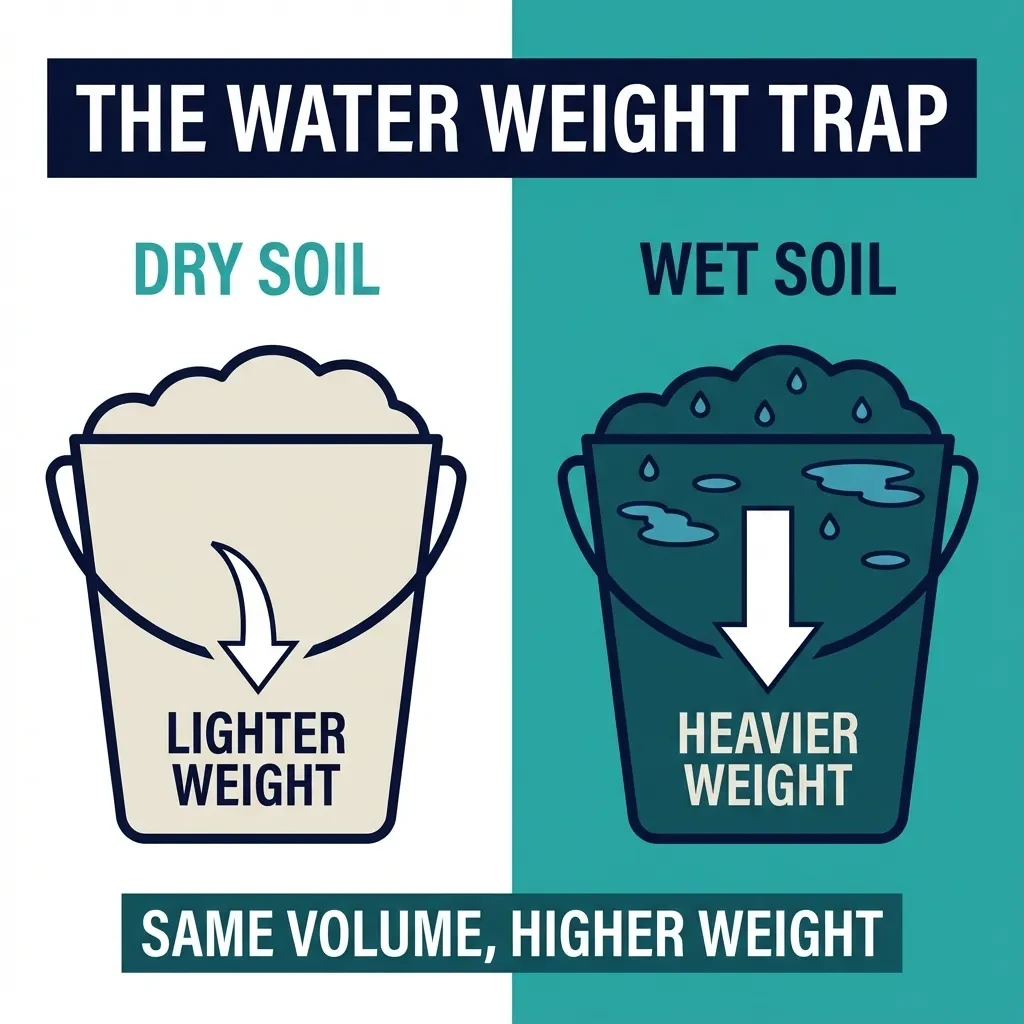
- Moisture: This is the big one. Water is heavy (8.34 lbs/gallon). A cubic yard of dry dirt might weigh 2,200 lbs. That exact same pile of dirt, after a rainstorm, could weigh 3,000 lbs.
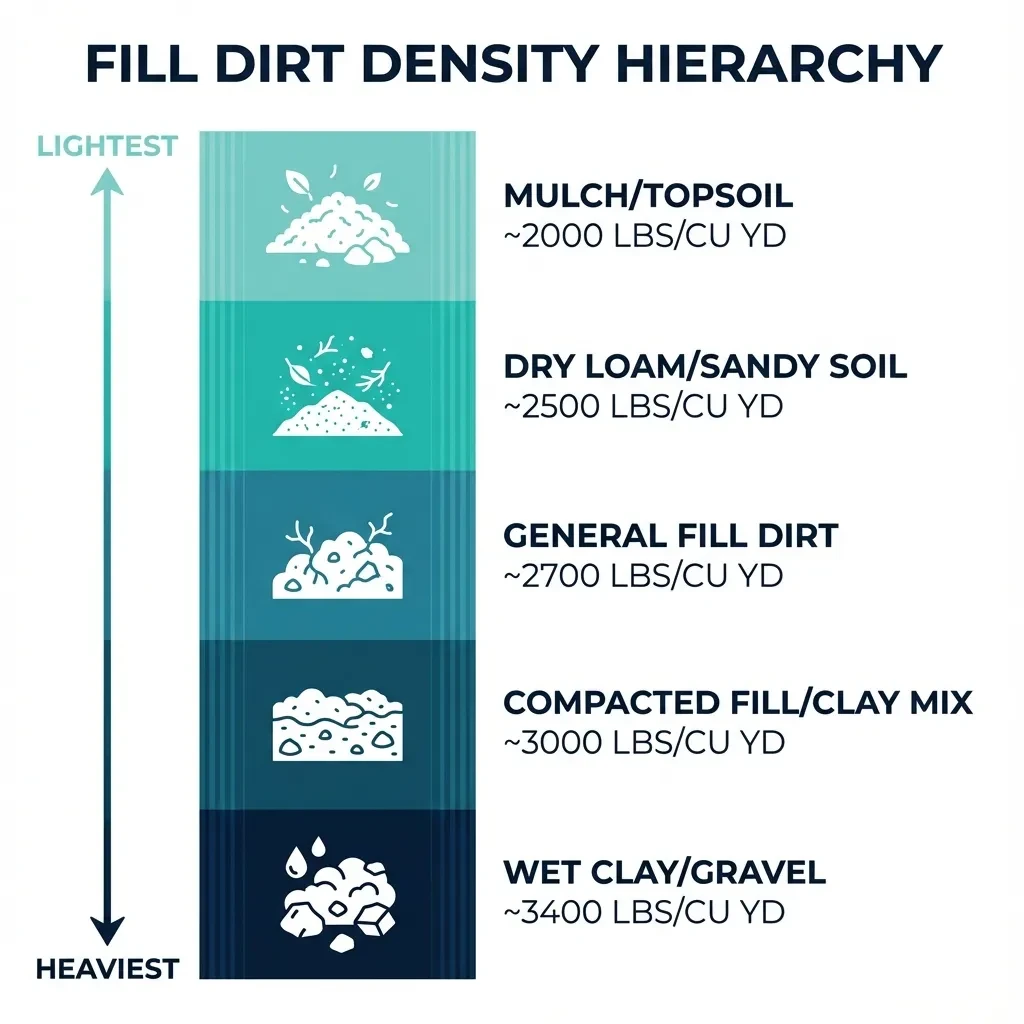
Fill Dirt Weight Chart by Material Type
Not all "dirt" is created equal. Using the wrong density factor is the #1 reason for calculation errors. Use this detailed chart to identify the specific material you are using.
| Material Type | Lbs Per Cubic Yard | Tons Per Cubic Yard | Density Type |
|---|---|---|---|
| Topsoil (Screened) | 2,000 - 2,200 lbs | 1.0 - 1.1 tons | Low Density |
| Sandy Fill Dirt | 2,300 - 2,500 lbs | 1.15 - 1.25 tons | Medium-Low |
| Common Fill (Mixed) | 2,400 - 2,700 lbs | 1.2 - 1.35 tons | Standard Average |
| Clay Fill (Dry) | 2,500 - 2,800 lbs | 1.25 - 1.4 tons | Medium-High |
| Gravel / Stone | 2,700 - 2,900 lbs | 1.35 - 1.45 tons | High Density |
| Wet / Saturated Fill | 2,900 - 3,400 lbs | 1.45 - 1.7 tons | Max Density |
| Compacted Road Base | 3,000 - 3,500 lbs | 1.5 - 1.75 tons | Structural |
Detailed Material Breakdown
1. Topsoil (1.0 - 1.1 Tons/CY)
Topsoil is the lightest form of dirt because it is rich in organic matter (decomposed leaves, roots) which is porous and fluffy. It is typically screened to remove rocks, adding air to the mixture. Warning: Do not use for structural filling; it will settle significantly.
2. Sandy Fill (1.2 Tons/CY)
Sand particles are larger than clay but pack together less tightly than mixed soil due to their shape. Dry sand is deceptively light, but it absorbs water readily.
3. Common Fill / Borrow (1.3 Tons/CY)
This is the "standard" dirt dug out of a hill. It contains a mix of rocks, sand, clay, and silt. It is the most common material used for raising grades or filling large holes. Industry default uses 1.3 tons.
4. Heavy Clay (1.4 - 1.6 Tons/CY)
Clay particles are microscopic and flat, allowing them to stack incredibly tightly. Dense clay is significantly heavier than topsoil. Use 1.4 tons for dry clay, up to 1.6 or 1.7 tons for wet, sticky clay.
The "Wet Dirt" Factor: Moisture Impact
If density is the magic number, moisture is the invisible thief. You can order 10 cubic yards of dry fill dirt in July, and it might weigh 13 tons. Order that same 10 cubic yards in April after a week of rain, and simple water retention could make it weigh 16 tons.
Here is the trap: If you are buying by the ton, water makes you pay more for the exact same amount of "dirt."
Seasonal Ordering Strategy
- 🌱Spring (March - May): Expect material to be heavier. The ground is thawing and saturated. Quarry stockpiles are wet. Factor: Use 1.4 to 1.5 tons/yard.
- ☀️Summer (July - September): Material is usually driest. This is the most economical time to buy by the ton. Factor: Use 1.2 to 1.3 tons/yard.
- ❄️Winter (December - February): Dirt may be frozen into massive clumps. Hard to grade and deceptively heavy due to ice. Avoid if possible.
How to Calculate Fill Dirt Scenarios (Step-by-Step)
Calculating the tonnage isn't complex algebra, but it does require following a specific order of operations to ensure accuracy.
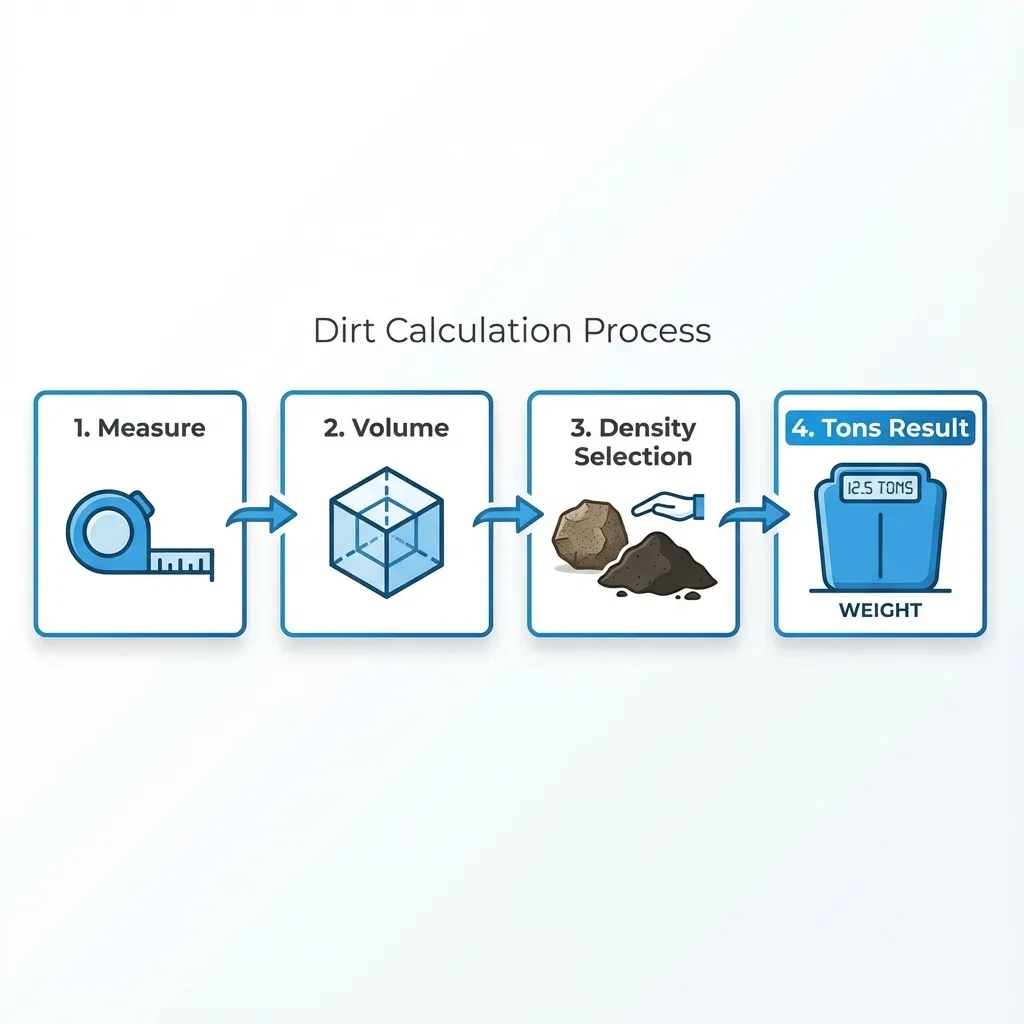
Step 1: Measure Dimensions
Measure Length, Width, and Depth in feet. Convert inches to decimal (6 inches = 0.5 ft).
Step 2: Calculate Volume
(L × W × D) ÷ 27 = Cubic Yards
Step 3: Apply Density
Cubic Yards × 1.3 (or specific factor) = Tons
Step 4: Compaction Buffer
Add 15-20% to final tonnage for settling.
Real World Project Examples
Scenario 1: The Backyard Patio Base
The Project: 20' x 20' patio, 6-inch base of sandy fill.
- Volume: 20' × 20' × 0.5' ÷ 27 = 7.41 cubic yards.
- Density (Sandy Fill): 1.25 tons/yard.
- Raw Weight: 7.41 × 1.25 = 9.26 tons.
- With 15% Buffer: 9.26 × 1.15 = 10.65 tons.
- Order: 11 Tons.
Scenario 2: The Raised Driveway
The Project: 100' x 12' driveway, raised 4 inches (0.33 ft).
- Volume: 100' × 12' × 0.33' ÷ 27 = 14.67 cubic yards.
- Density (Compactable Clay): 1.45 tons/yard.
- Raw Weight: 14.67 × 1.45 = 21.27 tons.
- With 10% Buffer: 23.4 tons.
- Order: 24 Tons (Typical large single load).
Cubic Yards vs. Tons: Which Should You Order?
Order by Cubic Yard When:
- ✅ Filling a specific measured hole
- ✅ Ordering light materials (Mulch/Topsoil)
- ✅ Picking up in a small truck
- ✅ Supplier prices by volume
Order by Ton When:
- ✅ Ordering large bulk deliveries
- ✅ Dealing with quarries directly
- ✅ Ordering heavy gravel/stone/clay
- ✅ Need precise weight for truck limits
Cost Analysis: Price Per Ton vs. Price Per Yard
Don't be fooled by the sticker price. A "cheaper" price per ton might actually cost you more if you don't understand the conversion.
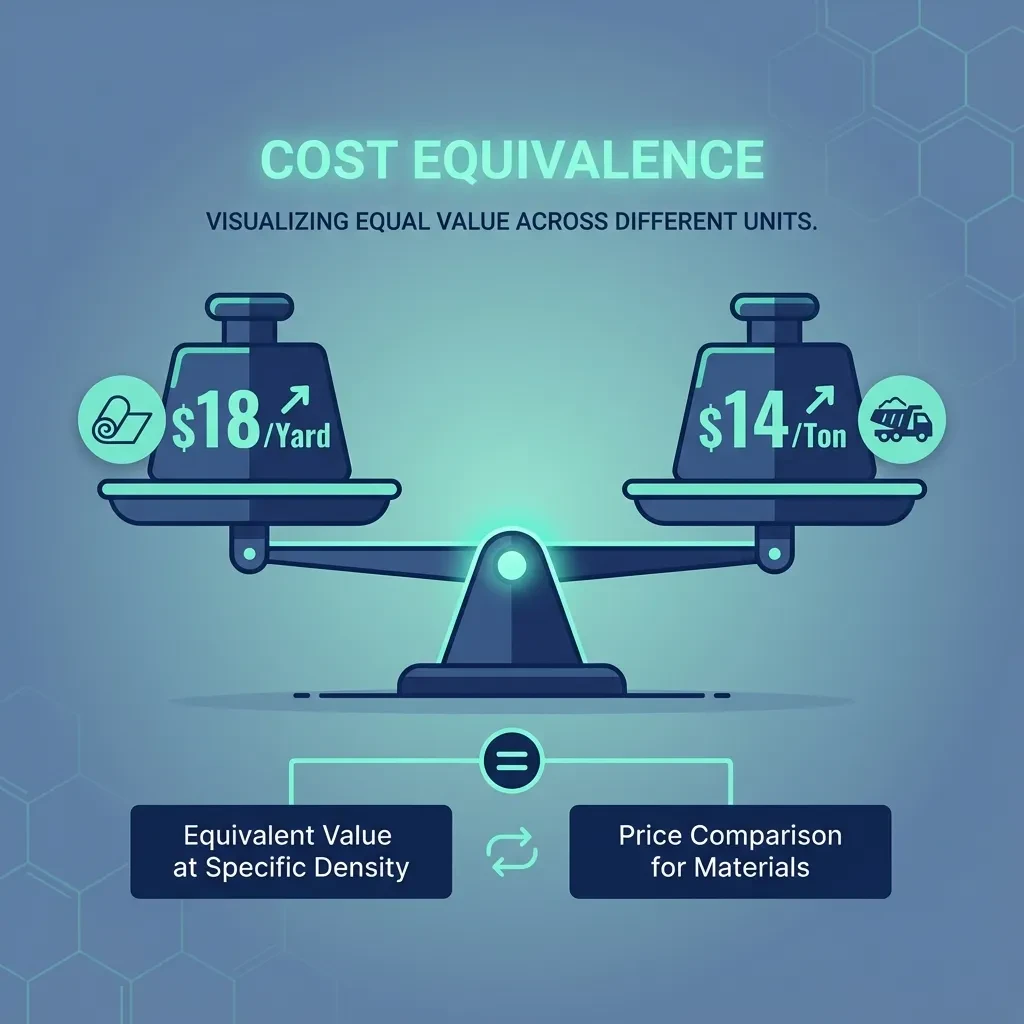
The Equivalence Formula
Price Per Yard ÷ 1.3 ≈ Price Per Ton
Example:
Supplier A: $20/yard ÷ 1.3 = $15.38/ton equivalent.
Supplier B: $16/ton.
Verdict: Supplier A is actually cheaper!
Dump Truck Sizes and Tonnage Capacities
One of the most practical reasons to calculate tonnage is to plan for delivery. You cannot fit 20 tons of dirt in a pickup truck—in fact, putting just 2 tons in a standard F-150 could snap the axle.
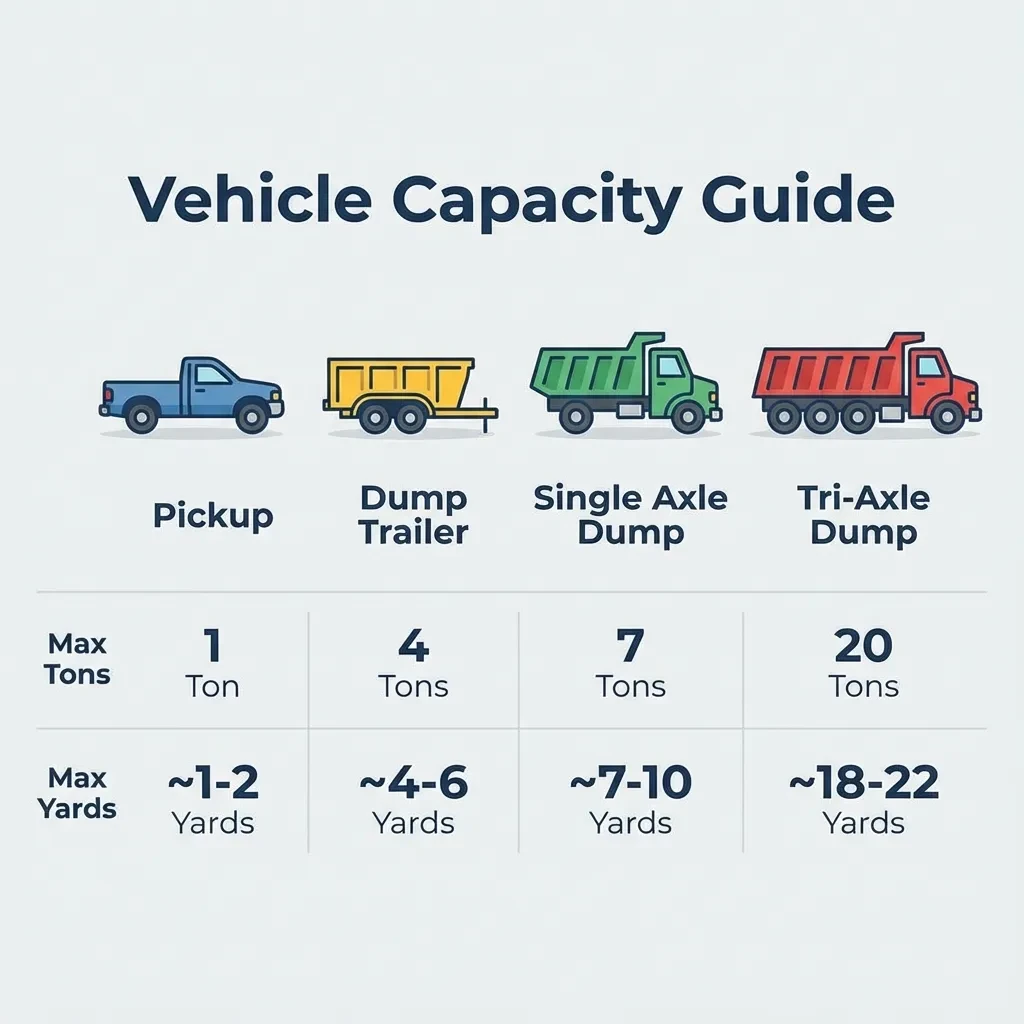
Pickup Truck
0.5 - 1.5 Tons
Very small projects
Dump Trailer
3 - 5 Tons
DIY Heavy Duty
Single Axle
5 - 7 Tons
Residential driveways
Tri-Axle
18 - 22 Tons
Major construction
7 Common Mistakes When Converting Dirt to Tons
- Using Topsoil Density for Clay: Don't use 1.0 ton/yard for clay (1.4 tons); you'll end up with massive shortages.
- Ignoring Rain: Buying tons of wet dirt pays for water. Check the weather.
- Confusing Ton Types: Ensure your supplier uses the US Short Ton (2,000 lbs), not Metric Tonne (~2,204 lbs).
- Overloading Pickups: One yard of dirt (2,600 lbs) exceeds most half-ton truck limits.
- Forgetting Fluff Factor: Loose dirt settles. Always add a buffer.
- Guessing Depth: Eyeballing depth leads to the biggest volume errors. Use a string line.
- Ignoring Minimums: Buying 4 tons when the truck minimum is 15 tons wastes money.
Conclusion
Converting cubic yards to tons is the professional way to approach any large earth-moving project. It allows you to speak the same language as the suppliers, ensure legal and safe transport, and compare prices accurately.
Remember the Golden Rules: Measure carefully in feet, use 1.3 tons/yard as your baseline (adjusting for material), add 15-20% for compaction, and always check if price-per-ton beats price-per-yard.
Frequently Asked Questions
How many tons is 1 cubic yard of fill dirt?
On average, 1 cubic yard of fill dirt weighs approximately 1.3 tons (2,600 pounds). However, this density varies. Loose topsoil may weigh 1.0 ton per yard, while wet clay typically weighs 1.5 to 1.7 tons per cubic yard.
How many yards of dirt are in a dump truck?
A standard single-axle dump truck carries 5-7 yards. Tandem-axle trucks hold 10-12 yards. Large tri-axle dump trucks typically haul 15-20 yards, depending on weight limits and material density.
Is it cheaper to buy dirt by the ton or yard?
It depends on the density. Generally, dense materials like gravel or stone are better purchased by the ton, while lighter bulk items like mulch are better by the yard. To compare, divide the price-per-yard by 1.3. If the result is lower than the price-per-ton, the per-yard price is the better deal.
How much does a yard of wet dirt weigh?
Wet dirt is significantly heavier than dry dirt. A cubic yard of dry fill might weigh 2,200 lbs, while the same yard saturated with water can weigh over 3,000 lbs (1.5 tons), increasing costs when buying by weight.
What is the density of clay fill dirt?
Clay is naturally denser than sandy soil. Dry, chunky clay typically weighs 1.3 to 1.4 tons per cubic yard. Wet clay is extremely dense and heavy, often reaching 1.6 to 1.7 tons per cubic yard due to its ability to retain water within its tight particle structure.
How many tons of dirt do I need for a 20x20 area?
For a 20x20 area fill (400 sq ft) at a depth of 6 inches (0.5 ft), you have 200 cubic feet, or 7.4 cubic yards. Multiplying by the standard 1.3 factor, you would need approximately 9.6 tons of fill dirt. We recommend ordering 11 tons to account for compaction.
How much does a pickup truck load of dirt weigh?
A full standard pickup bed (approx 2 cubic yards volume-wise) of fill dirt would weigh over 5,000 lbs (2.6 tons), which far exceeds the 1,500-2,000 lb payload capacity of most F-150/1500 series trucks. Safe hauling in a half-ton pickup is limited to about 0.5 to 0.75 cubic yards.
Does topsoil weigh less than fill dirt?
Yes. Screened topsoil is composed of organic matter and is aerated during the screening process. It typically weighs 2,000-2,200 lbs (1.0-1.1 tons) per cubic yard, making it approximately 20-25% lighter than standard mineral-rich fill dirt or clay.
How much weight does water add to dirt?
Water weighs 8.34 lbs per gallon. Soil can hold 20-40% of its volume in water. This means a cubic yard of soil can hold 30-50 gallons of water, adding 250 to 500 lbs (0.12 to 0.25 tons) to the weight of a single yard.
What represents a ton of dirt visually?
Visually, 1 ton of fill dirt is a pile approximately 3 feet wide, 3 feet long, and 2 feet high. It is slightly less than a full cubic yard (which is 3x3x3). Think of it as filling about two-thirds of a standard bulk material bag.
How do I calculate tonnage for irregular shapes?
Break the irregular shape into smaller rectangles or circles. Calculate the volume (cubic yards) for each section separately, add them together to get the total volume, and then multiply the total cubic yards by 1.3 to determine the total tonnage.
What is the conversion factor for gravel vs. dirt?
Gravel is denser than dirt because rock is heavier than soil minerals and packs tighter. While dirt uses a 1.3 factor, crushed gravel or limestone road base typically uses a 1.4 to 1.5 conversion factor (approx 2,800-3,000 lbs per yard).
Do I generally need more tons than cubic yards?
Yes. Because the conversion factor is greater than 1.0 (typically 1.3), the number of tons will always be roughly 30% higher than the number of cubic yards. For example, 10 cubic yards equals 13 tons.
How accurate are online dirt calculators?
Online calculators provide theoretical estimates based on averages. Real-world accuracy depends on the specific moisture content and mineral composition of the dirt delivered. They are excellent for planning and budgeting but always round up 10-15%.
Can I return excess gravel or dirt?
Generally, no. Once bulk material is dumped on your property, suppliers will not pick it up. In fact, you would likely have to pay a removal service to haul it away. This is why calculating accurately is critical.