Back Fill Dirt Calculator
Accurate Trench, Foundation & Compaction Calculations
By Todd Bly, B.S. Construction Management · Updated October 2026
Pro Fill Dirt Calculator
Accurate estimates for Yards, Tons, & Compaction
Results
How to Calculate Back Fill Dirt
The Formula
We calculate the net void volume by subtracting pipes/tanks, then add a material-specific Compaction Factor to account for shrinkage.
Measure Accurately
Measure in feet. For depth, measure in inches and our tool handles the conversion (divide by 12).
Check Your Shape
Most back fill dirt projects are rectangles. If irregular, break it into smaller shapes.
Add Compaction
Under-ordering backfill leads to costly project delays, while using the wrong material type can cause foundation drainage failure.
Backfilling is one of the most deceptive tasks in construction. To the untrained eye, it looks like simply "putting the dirt back in the hole." In reality, it is a complex engineering challenge involving soil mechanics, compaction ratios, and displacement physics.
Whether you are covering a 4-inch sewer line or filling the void around a new basement foundation, the math is never 1:1. The dirt you dig out "bulks" up, but the dirt you ram back in "shrinks." This guide and our Back Fill Dirt Calculator are designed to bridge that gap, ensuring you order exactly the right amount of material—no more, no less.
How to Calculate Backfill Dirt Volume
The core challenge of backfill calculation is determining the Net Void Volume. You aren't just filling a hole; you are often filling the space around an object (like a pipe, tank, or manhole) inside that hole.
Net Volume = (Trench Length × Width × Depth) - Object Volume
Step-by-Step Calculation Guide
- Measure the Excavation: Determine the total length, width, and depth of the trench or hole. Calculate this gross volume in cubic feet.
- Calculate the Object Displacement: If you are burying a pipe or tank, calculate its volume.
- Pipe Volume Formula: π × r² × Length
- Tank Volume: Check manufacturer specs.
- Subtract and Adjust: Subtract the object volume from the trench volume. This is your "Net Void."
- Apply Compaction Factor: Multiply the result by 1.15 to 1.25 (15-25%) to account for soil shrinkage. This is the step most people forget.
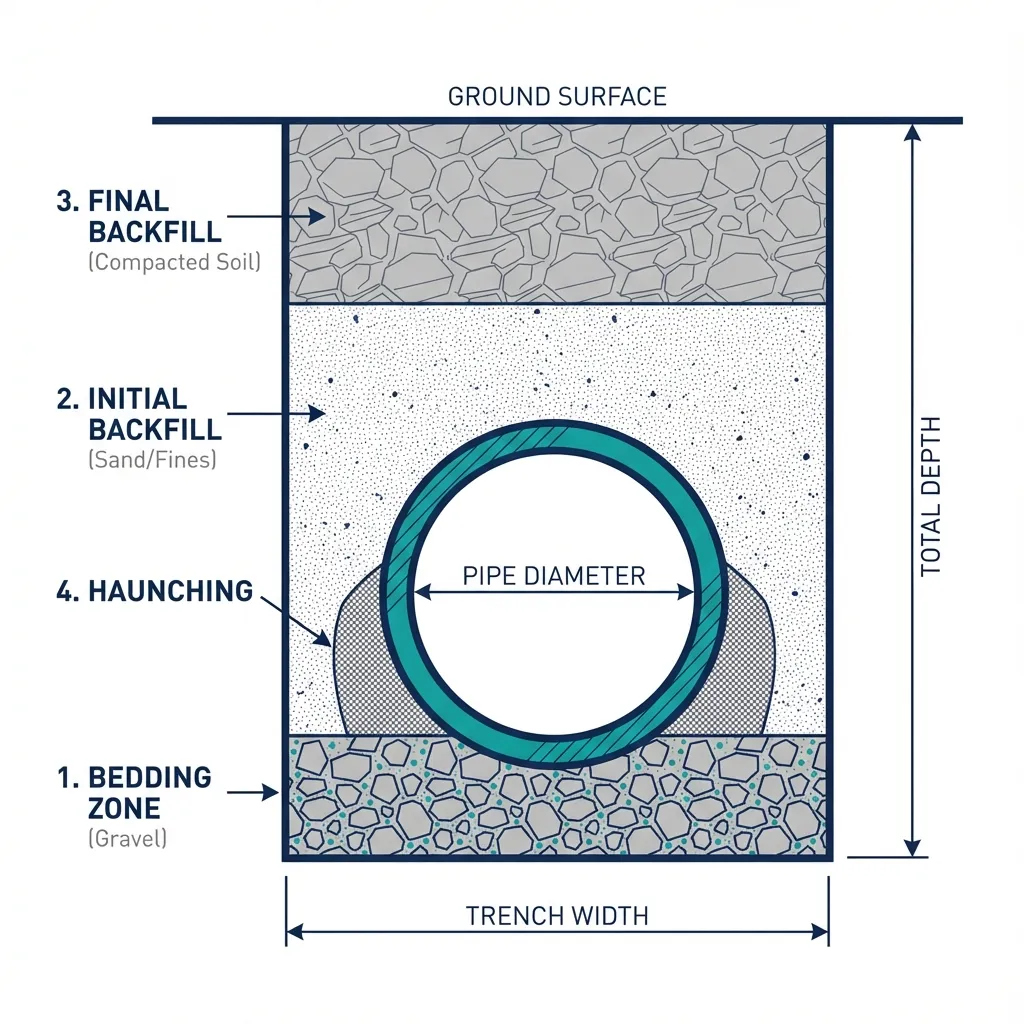
The 4 Zones of Utility Trench Backfill
Professional utility trenches are not just filled with random dirt. They are engineered in layers (zones), each with a specific purpose. Ignoring these zones can lead to pipe rupture or ground settlement.
- 1. Bedding Zone:
4-6 inches of sand or crushed stone UNDER the pipe. This provides a level, non-abrasive foundation.
- 2. Haunching:
Soil placed on the sides of the pipe. This must be tamped carefully to prevent the pipe from shifting.
- 3. Initial Backfill:
6-12 inches of rock-free soil directly OVER the pipe. Protects the utility from the crushing weight of the final fill.
The Hidden Variable: Compaction & Shrinkage
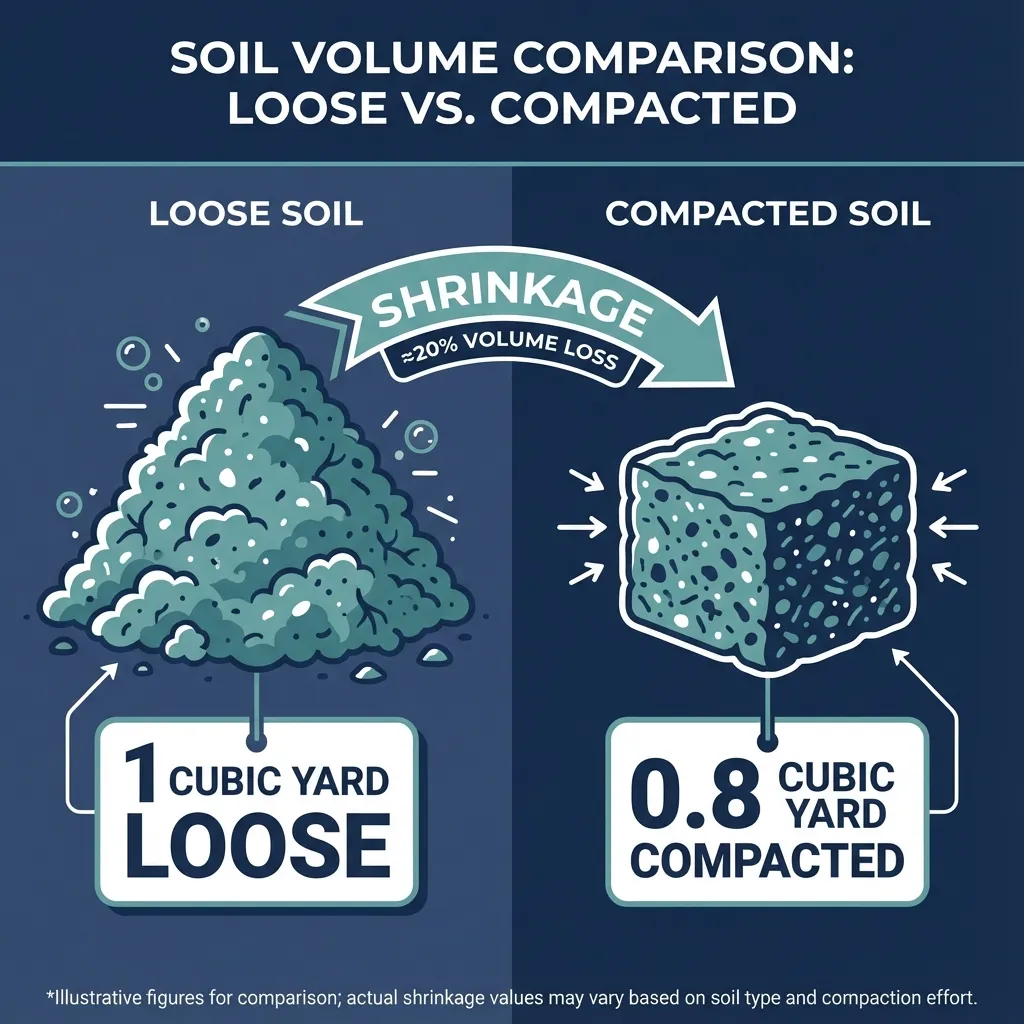
When you order dirt, it comes "loose" in a truck. When you install it, you "compact" it with a machine. 1 cubic yard of loose dirt does NOT fill a 1 cubic yard hole.
You must order extra material to compensate for this shrinkage. This is known as the "Compaction Factor." Learn more about proper compaction calculations.
| Material Type | Compaction Factor (Add-on) | Best Use |
|---|---|---|
| Bank Run Sand | 10% - 15% | Utility trenches, pipe bedding |
| Crushed Stone (#57) | 5% - 8% | Drainage zones, wet areas |
| Common Clay/Dirt | 20% - 30% | General site grading (Not structural) |
| Topsoil | 15% - 20% | Final 6 inches (surface only) |
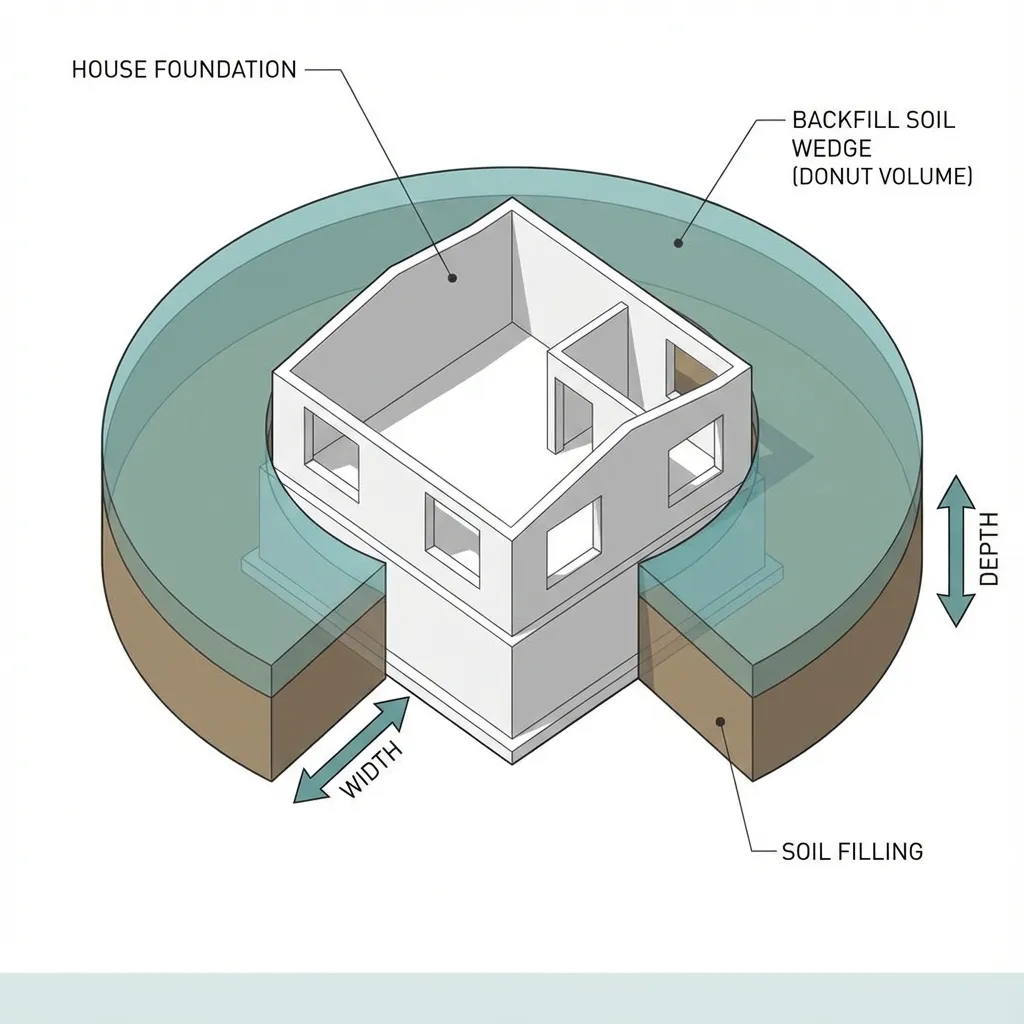
Calculating Foundation Backfill (The "Donut")
Backfilling around a house foundation is tricky because you are filling a wedge-shaped void. The excavation is usually wider at the top than at the bottom (to prevent collapse during construction).
To calculate this volume manually, you essentially calculate the volume of the entire excavated pit, and then subtract the volume of the basement itself.
Critical Warning: Trench Safety
Trench collapse is the #1 cause of death in excavation work. A cubic yard of soil weighs nearly 3,000 lbs—the weight of a small car. If a trench walls collapses, there is no time to escape.
Permit required. Any trench 5 feet or deeper MUST have shoring, shielding (trench box), or sloping.
Keep spoil piles (dirt you dug out) and heavy equipment at least 2 feet back from the trench edge.
Never enter a trench alone. Always have a spotter above ground who can call for help.
Ready to start filling?
Don't let a bad estimate delay your project. Use our free calculator to get precise numbers, order the right amount of fill, and keep your jobsite safe/
Frequently Asked Questions
How do I calculate backfill for a trench?
Measure Length × Width × Depth to get volume. Subtract the volume of the pipe (πr² × L). Finally, add 15-20% for compaction shrinkage.
What is the best dirt for backfilling?
For utility trenches, gravel or sand is best for the 'bedding' zone around the pipe. For the rest of the trench, native soil is fine IF it's not heavy clay. 'Select Fill' (sandy loam) is the safest all-purpose choice.
What is the compaction factor for backfill?
It depends on the material. Sand shrinks 10-15%, gravel shrinks 5-10%, and clay/topsoil shrinks 20-30%. Always order extra to account for this.
Can I use the dirt I dug out to backfill?
Often, yes, but not always. If the soil is full of large rocks, roots, or trash, it cannot be used near pipes. If it's heavy clay, it shouldn't be used against foundations.
How much gravel do I need for pipe bedding?
A standard rule is 4-6 inches of bedding UNDER the pipe and 6 inches OVER the pipe. Calculate this volume as a rectangular box (Trench Width × 1 ft height × Length).
