Clean Fill Dirt Calculator
Instantly calculate volume, tons, and cost for clean fill dirt projects. Account for compaction and get accurate delivery estimates.
By Todd Bly, B.S. Construction Management · Updated October 2026
Pro Fill Dirt Calculator
Accurate estimates for Yards, Tons, & Compaction
Results
How to Calculate Clean Fill Dirt
The Formula
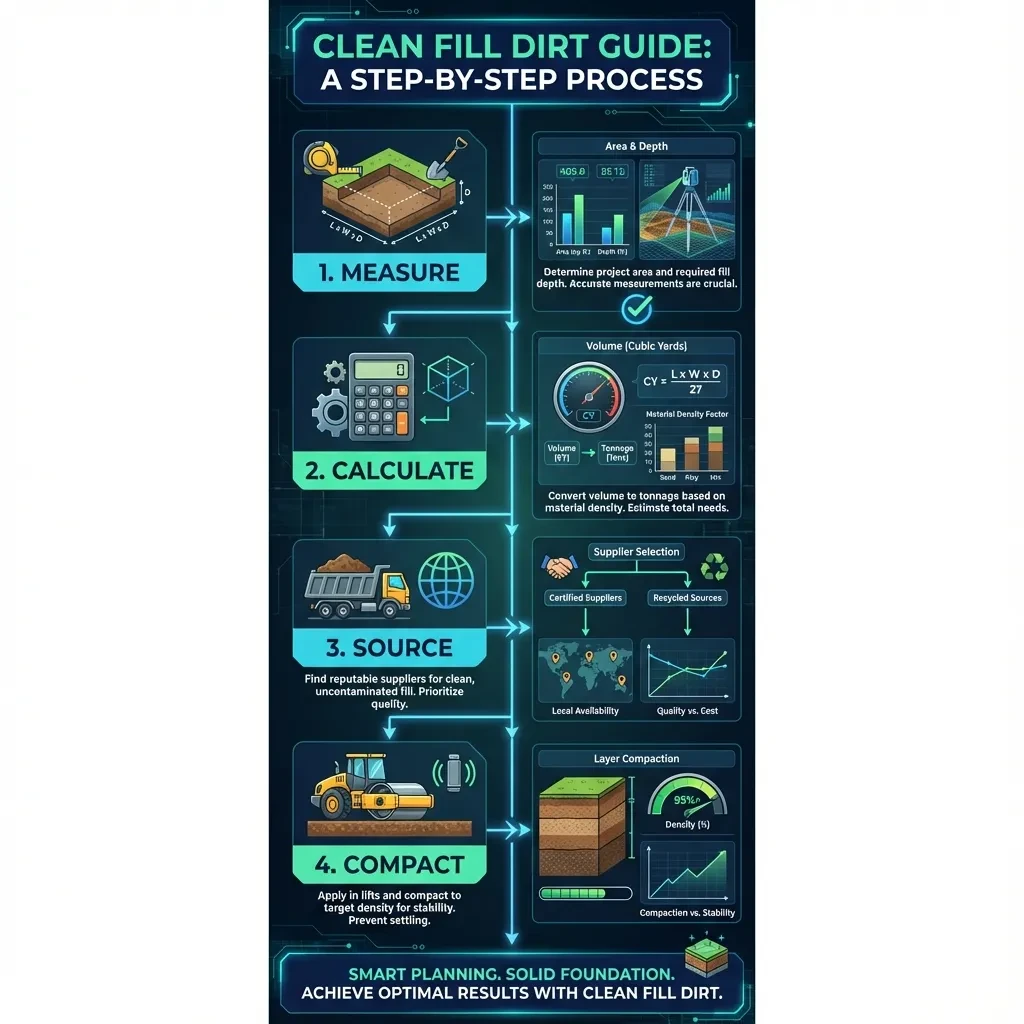
Measure Length, Width, and Depth in feet. Multiply them to get Cubic Feet. Divide by 27 to convert to Cubic Yards. Always add 10-20% for compaction.
Measure Accurately
Measure in feet. For depth, measure in inches and our tool handles the conversion (divide by 12).
Check Your Shape
Most clean fill dirt projects are rectangles. If irregular, break it into smaller shapes.
Add Compaction
Ordering the wrong amount of fill dirt is expensive. Too little means extra delivery fees; too much means removal costs. Our calculator accounts for the 'compaction factor' to ensure you get it right the first time.
When you are breaking ground on a new construction project, whether it is grading a backyard, backfilling a foundation, or filling in an old swimming pool, one question stands between you and success: How much dirt do I actually need?
It sounds like a simple math problem. Length times width times depth. But in the world of excavation and landscaping, simple math often leads to expensive mistakes. Ordering too little clean fill dirt means your project grinds to a halt while you pay for a second delivery fee. Ordering too much means you are left with a massive pile of earth and a bill for hauling it away.
The Clean Fill Dirt Calculator above is designed to eliminate that guesswork. This comprehensive guide will walk you through calculating volume, accounting for compaction, and understanding the differences between "clean fill" and "topsoil."
Table of Contents
How to Calculate Fill Dirt Volume
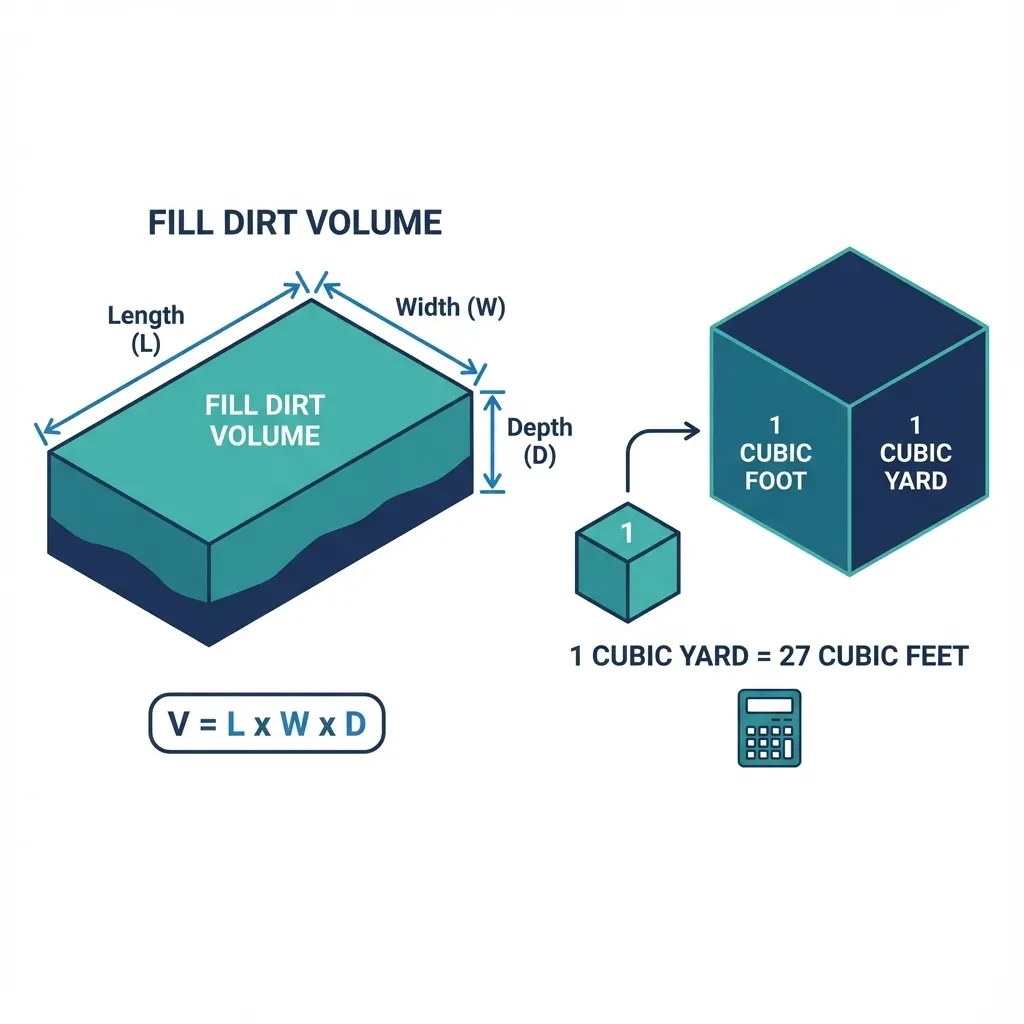
At its core, calculating dirt needs is a volume equation. You are measuring a 3D space and converting it into Cubic Yards.
The Golden Formula
- Calculate Cubic Feet: Length (ft) × Width (ft) × Depth (ft) = Cubic Feet
- Convert to Cubic Yards: Divide Cubic Feet by 27. (Because 3'×3'×3' = 27 cu ft)
- Round Up: Always round to the nearest whole yard.
Measuring Tips
- Rectangular Areas: Measure length and width. For depth, take average measurement if bottom is uneven.
- Circular Areas: Use π × r² × depth. (Or use our calculator).
- Trenches: If adding a pipe, subtract the pipe's volume to avoid ordering too much.
Understanding Clean Fill Dirt
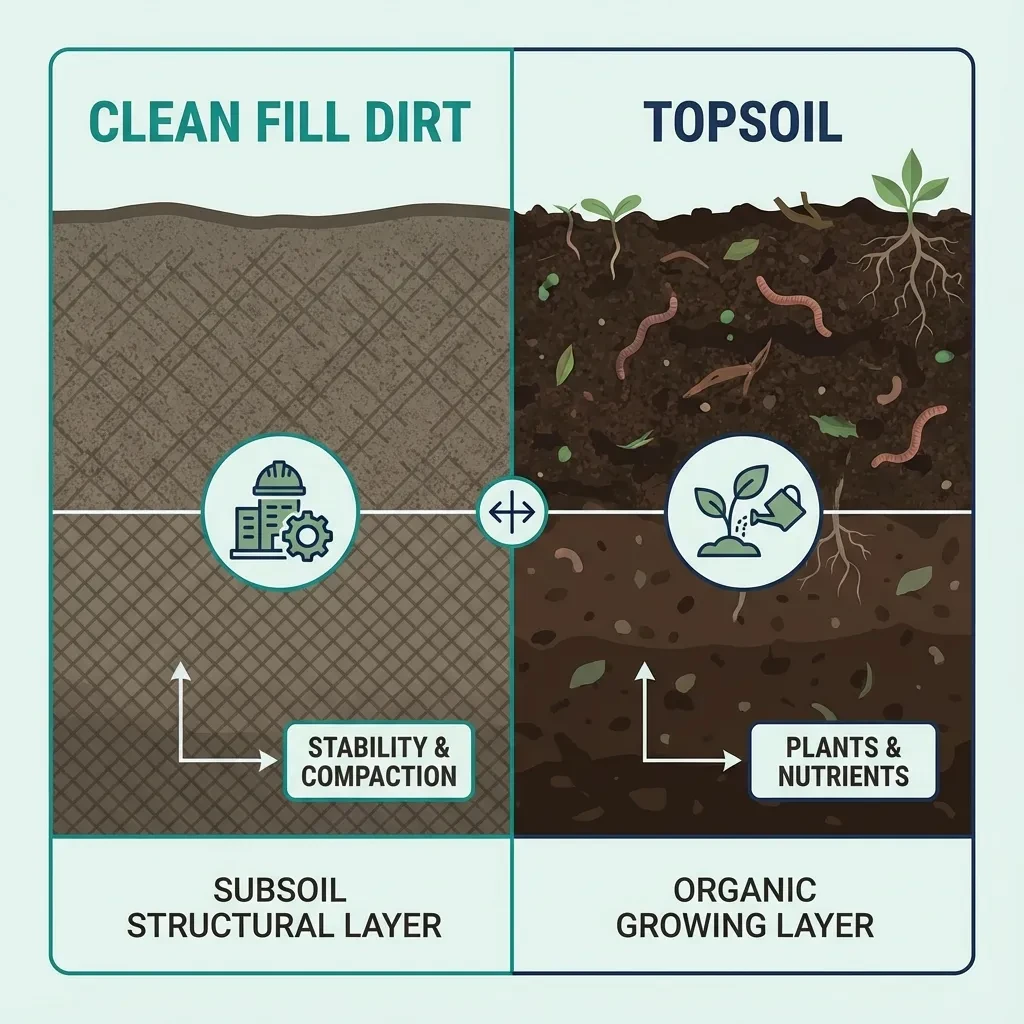
Clean Fill Dirt refers to subsoil screened to remove organic material, debris, toxins, and large rocks.
What "Clean" Means
Chemically and physically clean. No contamination (oil/metals), no organics (roots/leaves), no debris (concrete/trash).
Primary Use
Filling space to provide a solid, non-shifting base. It does not decompose, making it safe for foundations.
Clean Fill Dirt vs. Topsoil
| Feature | Clean Fill Dirt | Topsoil |
|---|---|---|
| Composition | Clay, Sand, Silt, Rocks | Organic Matter, Loam, Nutrients |
| Stability | High (Packs hard) | Low (Spongy, settles) |
| Best Use | Foundations, Raising Levels | Gardens, Lawns |
| Cost | Lower ($8 - $20 / yd) | Higher ($20 - $45 / yd) |
The "Compaction Factor": Why You Need 10-20% More
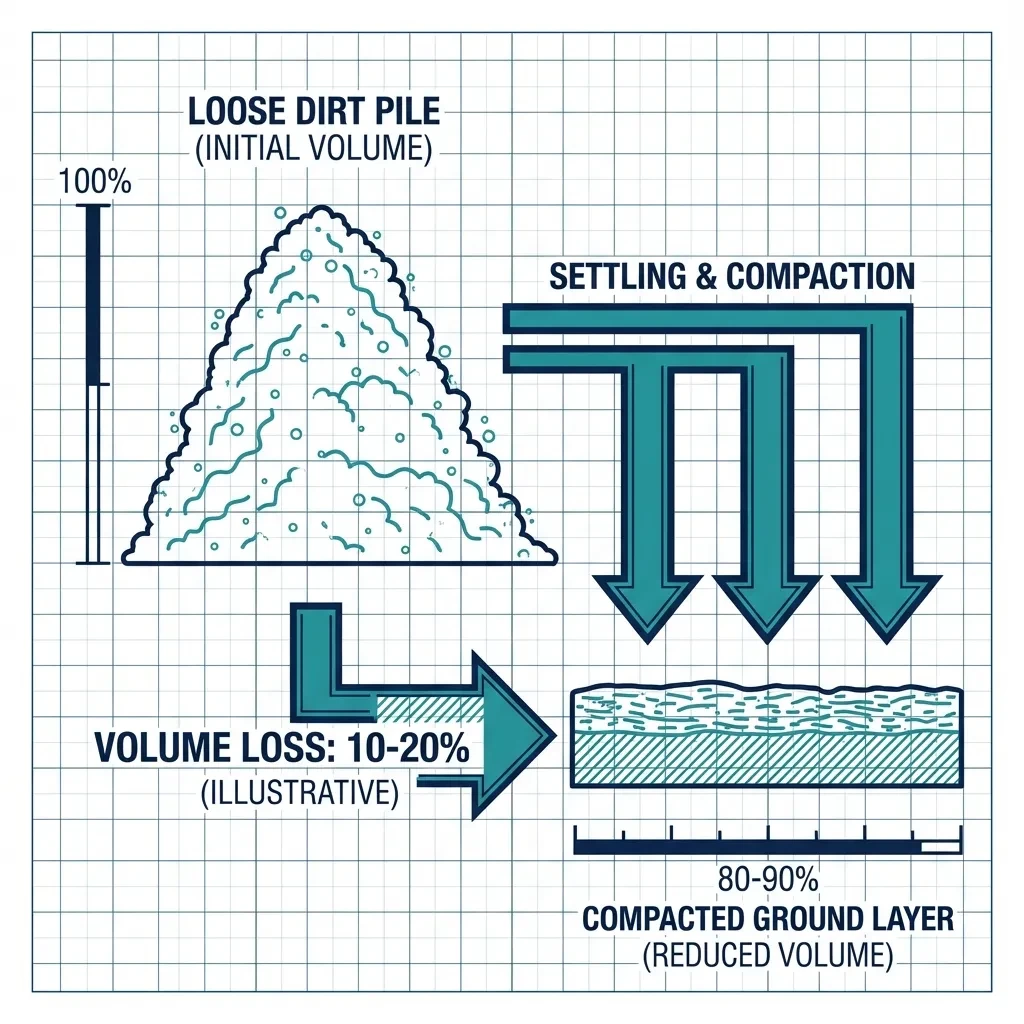
Dirt "fluffs up" when excavated. When you install and compact it, it shrinks. To avoid running short, you must add a buffer. Learn more about compaction factors.
Rule of Thumb
- 10% Buffer: For shallow areas or hand tamping.
- 20% Buffer: For deep holes (12"+) or mechanical compaction.
Calculated Yards × 1.2 = Order Amount
Estimating Fill Dirt Costs
Material Cost (2025)
- Screened Clean Fill $15 - $28 / yd
- Unscreened Fill $8 - $15 / yd
- Structural Fill $20 - $35 / yd
Delivery Fees
Delivery determines the final price. Expect flat fees per truckload.
- Local (0-10 miles) $50 - $150
- Regional (10-30 miles) $150 - $300
Practical Calculation Examples
Scenario 1: Filling a Pool (15' x 30' x 5')
Volume: 2,250 cu ft = 83.3 yards.
With 20% Compaction: Order ~100 cubic yards.
Scenario 2: Sloped Backyard (40' x 20' tapering from 0" to 12")
Avg Depth: 6" (0.5'). Volume: 400 cu ft = 14.8 yards.
With 10% Compaction: Order ~17 cubic yards.
Advanced Project Deep Dives
1. Filling in an In-Ground Pool
Don't just dump dirt! You must punch drainage holes in the concrete bottom to prevent creating a swamp. Fill in 12-inch layers ("lifts") and compact each layer individually. Top with 12 inches of good topsoil.
2. Retaining Wall Backfill
Never use standard fill dirt directly behind a wall (clay holds water and pushes walls over). Use a "drainage wedge" of clean crushed stone (gravel) directly behind the blocks, with fill dirt behind that.
3. Driveway Sub-Base
Remove all organic topsoil first (it sponges/moves). Use Structural Fill. Recommended: Lay a woven geotextile fabric between dirt and gravel to prevent mixing.
DIY vs. Pro: Who Should Do It?
DIY (Wheelbarrow)
One yard = ~2,000 lbs. That's 9-10 wheelbarrow trips per yard.
- Limit: 3-5 yards maximum.
- Risk: Back injury, exhaustion.
Equipment Rental
Rent a Skid Steer (Bobcat) or Mini-Excavator for 10+ yard projects.
- Cost: $250 - $500 per day.
- Speed: Move 20 yards in a few hours.
Sourcing Quality Dirt
Questions to Ask
- Is this "virgin fill" (fresh dig)?
- Is it screened? (Critical for hand work)
- What is the clay content?
Red Flags
- "Free Dirt" (often has trash/roots)
- Chemical/Gas/Sewage odors
- Visible debris (glass, wood, plastic)
Regional Regulations (USA)
New York (NYS DEC)
Strict on "uncontaminated soil." C&D debris is banned in residential fill. Long Island has aquifer protections.
California (CalRecycle)
Limits near waterways. "Fire ash" from wildfires is considered contaminated. Check with LEA for >100 yds.
Florida (FDEP)
Watch out for "Muck" (swamp soil). Radioactive phosphate soil is a risk in Central FL (ensure certified safe).
New Jersey (NJDEP)
"Dirty Dirt Law" requires all suppliers to be registered. Ask for NJDEP registration number.
The Environmental Cost of "Bad Dirt"
Using contaminated dirt is a health risk. Old orchard land can have arsenic; gas station dirt has oil.
The "Jar Test"
Put dirt in a jar of water and shake.
- Oil Sheen? Contaminated.
- Floaters? High organics (bad for fill).
- Quick Settling? Good sand/gravel content.
Explore More Resources
Frequently Asked Questions
How much does a cubic yard of fill dirt weigh?
A cubic yard of dry fill dirt typically weighs between 2,000 and 2,700 pounds (1 to 1.35 tons). If the dirt is wet (muddy), it can weigh over 3,000 pounds.
Can I use fill dirt for my garden or grass?
No. Fill dirt is subsoil with no nutrients. Use topsoil for the top 6 inches of any garden or lawn area.
How many wheelbarrows are in a cubic yard of dirt?
It takes approximately 4.5 to 5 contractor-size (6 cu ft) wheelbarrow loads to move one cubic yard of dirt. Standard garden carts (3 cu ft) take about 9 trips.
Does fill dirt drain water?
Generally, no. Fill dirt often contains clay which retains water. For drainage applications (like behind retaining walls), use clean crushed stone.
What is the difference between fill dirt and bank run?
Fill dirt is a general term. Bank run refers to unscreened dirt directly from an excavation site, often containing large rocks and debris.
How thick should I lay fill dirt?
Lay fill dirt in 'lifts' of 6 to 8 inches, compacting each layer individually. This prevents future settling/sinking.
Is fill dirt cheaper than topsoil?
Yes, significantly. Fill dirt is usually 50% to 70% cheaper than screened topsoil ($8-15/yd vs $30-50/yd).
Can I drive on fresh fill dirt?
Not immediately. Even with compaction, fill dirt can be soft when wet. Allow it to settle or cover with gravel for driveways.
How do I calculate fill dirt for a circle?
Use the formula: π (3.14) × Radius² × Depth. Or simply use the Circle option in our calculator above.
Do I need a permit to bring in fill dirt?
Small amounts (10-20 yards) usually don't require permits. Large grading projects (100+ yards) or work near flood zones often do.
What is Engineered Fill?
Engineered fill is soil certified to meet specific density/moisture standards (usually 95% Proctor density), required for structural foundations.
How much area does 1 yard of dirt cover?
One cubic yard covers roughly: 324 sq ft at 1 inch deep, 108 sq ft at 3 inches deep, or 54 sq ft at 6 inches deep.
Can I get fill dirt for free?
Yes, sites like FillFree.com exist, but be careful. Free dirt often contains debris, heavy clay, or contaminants.
What happens if I don't compact the dirt?
It will settle naturally over 6-12 months. Structures built on top will likely crack or tilt as the soil sinks.
Is Sandy Fill better than Clay Fill?
Sandy fill drains better and compacts easier (good for slabs). Clay fill is waterproof but harder to work with (good for ponds/dams).
