House Pad Fill Dirt Calculator
Calculate structural fill needed for residential building pads. Account for compaction, meet building code requirements, and estimate complete project costs including permits and testing.
By Todd Bly, B.S. Construction Management · Updated October 2026
Pro Fill Dirt Calculator
Accurate estimates for Yards, Tons, & Compaction
Results
How to Calculate House Pad Fill Dirt
The Formula
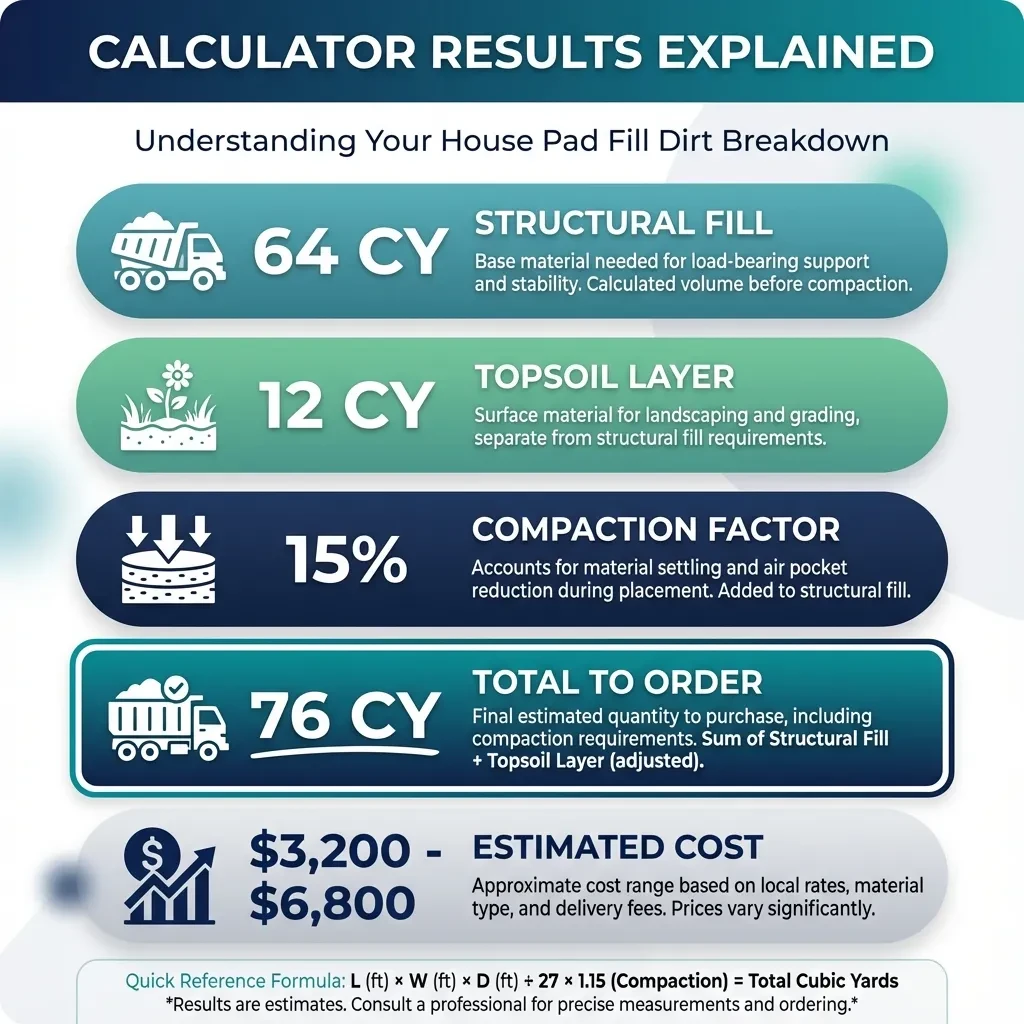
Calculate pad volume in cubic feet, divide by 27 for cubic yards, multiply by 1.15 for 15% compaction. Use structural fill for bulk (80%) and topsoil for final layer (20%).
Measure Accurately
Measure in feet. For depth, measure in inches and our tool handles the conversion (divide by 12).
Check Your Shape
Most house pad fill dirt projects are rectangles. If irregular, break it into smaller shapes.
Add Compaction
House pads require structural fill meeting building codes, 95% compaction verified by testing, and permit approvals. Using common fill fails inspections. Skipping compaction causes foundation settlement costing $10,000-$50,000 to repair.
What Is a House Pad and Why Does It Matter?
Definition and Purpose
A house pad is a prepared, level, and compacted area of land specifically engineered to support residential building construction. Unlike general yard grading or landscaping fill, house pads must meet strict building code requirements for load-bearing capacity, compaction density, drainage slope, and material specifications. The pad serves as the stable base upon which your foundation (whether concrete slab, crawl space, or basement) will be constructed.
House Pad vs General Fill Projects
House pad preparation differs fundamentally from yard leveling in several critical ways. Building codes mandate specific depth requirements (typically 8-12 inches minimum compacted fill), while yard grading has no such standards. House pads require structural fill dirt meeting engineering gradation specifications, whereas landscaping projects use common fill dirt. Compaction testing represents another major distinction - house pads must achieve 95% Standard Proctor density verified through field testing, with documentation provided to building inspectors.
Fill Dirt Types: Common Fill vs Structural Fill vs Topsoil
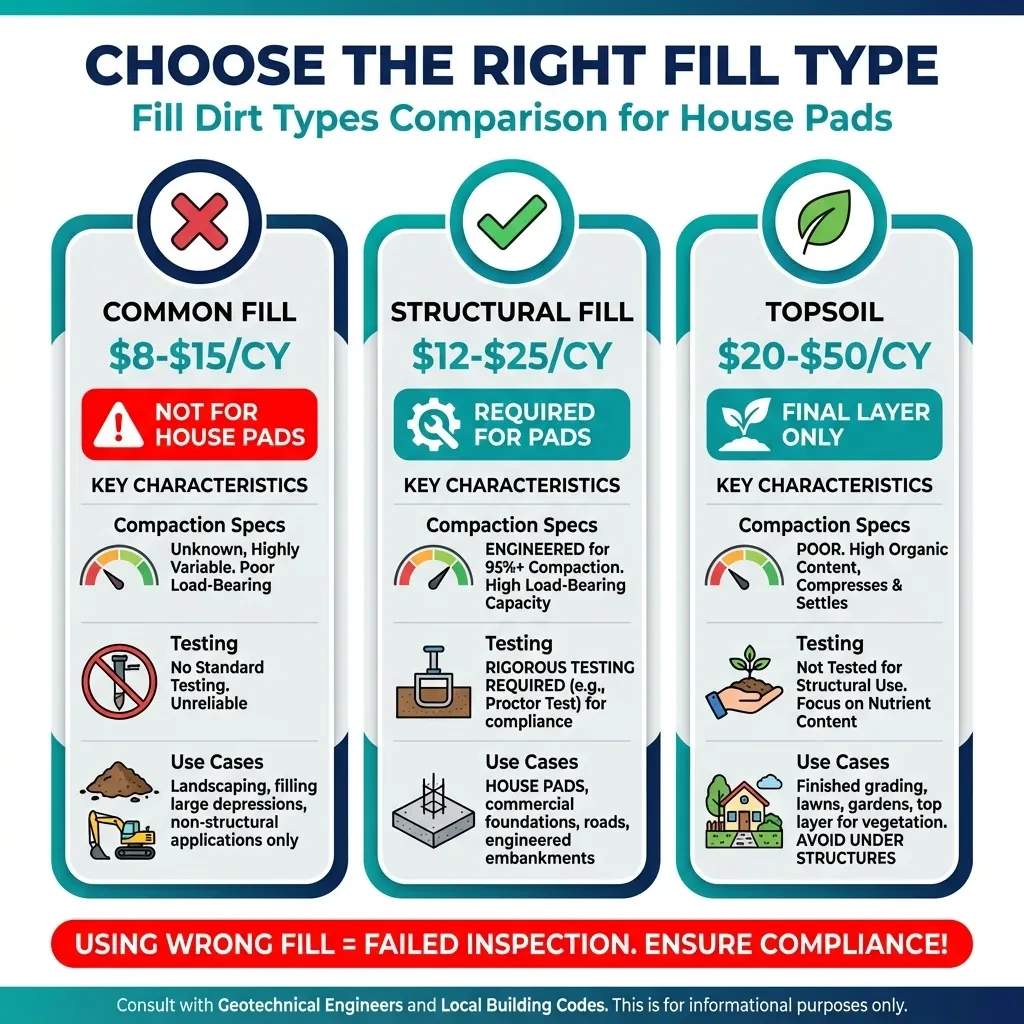
Common Fill Dirt - NOT Suitable for House Pads
Common fill dirt consists of excavation spoils from construction sites, containing native subsoil with varying amounts of clay, sand, silt, and often includes organic matter, roots, rocks, and debris. Suppliers sell common fill for $8-15 per cubic yard delivered, making it tempting for budget-conscious projects. However, common fill categorically fails to meet building code requirements for house pad construction and will result in failed building inspections.
Structural Fill - Required for Building Pads
Structural fill, also called engineered fill or select fill, meets specific gradation requirements tested through laboratory analysis. This material costs $12-25 per cubic yard delivered and contains controlled particle size distribution, typically ranging from fine sand to 3-4 inch maximum aggregate size. Engineering specifications for structural fill typically reference ASTM D2487 standards, requiring zero organic matter, frozen material, or construction debris.
Soil Compaction Requirements for House Pads
The 95% Compaction Standard
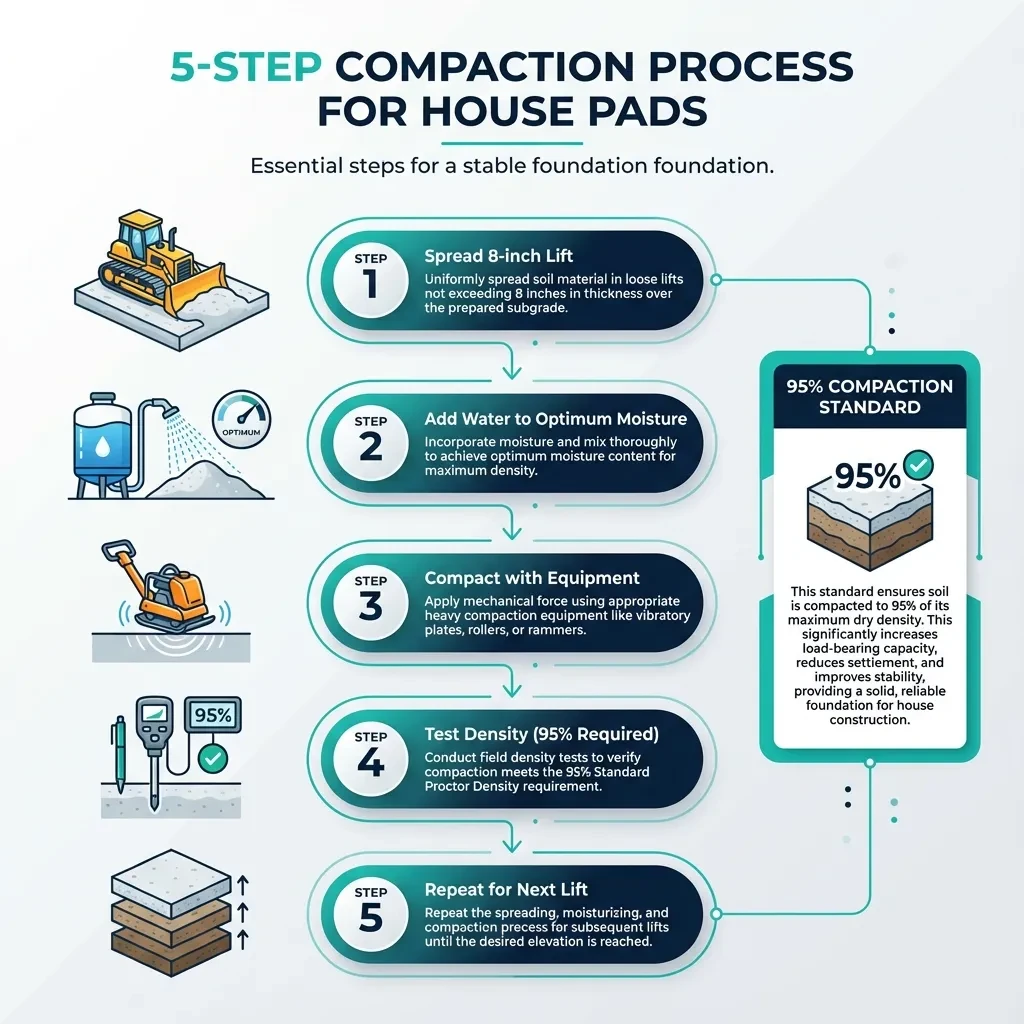
When building codes require "95% compaction," they reference 95% of maximum dry density as determined by the Standard Proctor test (ASTM D698). Laboratory technicians perform this test by compacting soil samples in standardized cylinders using specific energy input, then determining the maximum density achievable for that particular soil at its optimum moisture content. Field compaction must achieve 95% of this laboratory maximum density, verified through nuclear density gauges or sand cone tests.
Proper Compaction Technique
Achieving 95% compaction requires systematic approach starting with proper lift thickness. Spread structural fill in maximum 8-inch lifts (measured loose, before compaction). Thicker lifts prevent compaction equipment from densifying material at depth since plate compactors and rollers only effectively compact the upper 6-8 inches. Attempting 12-inch lifts leaves the bottom 4-6 inches uncompacted, creating future settlement zones.
Building Codes and Permit Requirements
When Building Permits Are Required
Nearly all jurisdictions require building permits for house pad preparation. Grading permits for earth moving operations typically cost $100-500 for residential grading permits. Permit applications require site plans showing existing and proposed elevations, drainage patterns, erosion control measures, and soil reports if geotechnical investigation was performed. Expect 1-4 week approval times depending on application completeness and building department workload.
Required Inspections
Required inspections typically include: initial site inspection before any work begins; mid-fill inspections during compaction (often one inspection per lift or every 2-3 lifts); compaction testing coordination with third-party labs; and final grade inspection before any topsoil placement or foundation work proceeds. Unpermitted house pad work discovered during subsequent building permit applications creates serious complications including potential removal requirements and substantial fines.
Complete Cost Breakdown
Small (1,000 sq ft)
$2,500 - $7,300
Materials: $766-$1,650
Labor: $1,500-$3,300
Plus: Testing, Permits, Engineering
Medium (1,500 sq ft)
$4,900 - $12,600
Materials: $1,244-$2,725
Labor: $2,500-$5,700
Plus: Testing, Permits, Engineering
Large (2,500 sq ft)
$8,400 - $19,800
Materials: $2,140-$4,600
Labor: $4,300-$9,500
Plus: Testing, Permits, Engineering
Common Mistakes When Preparing House Pads
Using Common Fill Instead of Structural Fill
Fails inspection, requires complete removal
Skipping Compaction Testing
Unknown density, potential foundation failure
Lifts Too Thick (Over 8 Inches)
Incomplete compaction at depth, settlement
No Slope or Flat Pad
Water pooling, failed inspection
Starting Without Permits
Stop work orders, fines, removal requirements
Wrong Moisture During Compaction
Poor compaction, failed density tests
Explore More Calculators
Planning additional fill dirt projects beyond your house pad? FillDirtCalculator offers specialized calculators for every fill dirt application:
- Fill Dirt Calculator (Homepage) - General purpose cubic yard calculator
- All Calculators - Browse our complete collection
- Compacted Fill Dirt Calculator - Calculate with compaction factors
- Pool Dirt Fill Calculator - Swimming pool removal calculations
Frequently Asked Questions
How many cubic yards of fill dirt do I need for a 1500 square foot house pad?
A 1,500 square foot house pad typically requires 55-70 cubic yards of structural fill depending on depth. For standard 12-inch depth: 1,500 sq ft × 1 foot = 1,500 cubic feet ÷ 27 = 55.6 cubic yards compacted. Add 15% for compaction (55.6 × 1.15 = 64 cubic yards to order) plus 12-15 cubic yards topsoil for the final layer. Total: 76-79 cubic yards.
What is the difference between structural fill and common fill dirt for house pads?
Structural fill is engineered material meeting specific gradation requirements, free from organic matter, costing $12-25 per cubic yard. Building codes require structural fill because it achieves reliable 95% compaction. Common fill is variable excavation spoils costing $8-15 per cubic yard but unsuitable for house pads. Using common fill fails inspections, requiring complete removal and replacement at costs exceeding $5,000-15,000.
Do I need a permit to build a house pad on my property?
Nearly all jurisdictions require grading permits for house pad earth moving, with fees ranging $100-500. Approval takes 1-4 weeks. Working without permits risks stop-work orders, fines of $500-5,000+, and requirements to remove unpermitted work. Always verify requirements with your building department before beginning site work.
How much does it cost to prepare a house pad with fill dirt?
Small house pads (1,000 sq ft) cost $2,500-$7,300 total. Medium pads (1,500 sq ft) range $4,900-$12,600. Large pads (2,500 sq ft) cost $8,400-$19,800. Costs include materials, labor, testing, permits, and potential engineering. Material expenses represent only 30-40% of total costs.
Can I use dirt excavated from my basement as fill for the house pad?
Basement excavation dirt can potentially serve as house pad fill ONLY if it meets structural fill specifications: appropriate gradation, no organic matter, correct moisture content, and provides compaction test results meeting 95% density. Have excavated material tested by geotechnical labs before using it as structural fill.
How deep should a house pad be for residential construction?
Building codes typically require 8-12 inches minimum compacted structural fill depth. Southern states commonly require 8-10 inches. Northern regions require 12+ inches. Sites with poor native soil may need 18-24 inches. Always verify with local building officials before finalizing calculations.
What does 95% compaction mean and why is it required?
95% compaction means field density must reach 95% of maximum dry density determined by laboratory Standard Proctor testing. This standard ensures fill achieves adequate load-bearing capacity, resists settlement under foundation loads, and provides long-term stability. Lower compaction leaves air voids that collapse under structural weight.
How long does it take to prepare a house pad from start to finish?
Complete house pad preparation typically requires 2-12 weeks total from permit application to final inspection approval. Permit approval takes 1-4 weeks. Active construction includes 8-20 working days depending on pad size and complexity. Small, simple pads might complete in 8-10 active working days.
Can I build a house pad myself or do I need a contractor?
Small, simple pads under 1,000 sq ft on level sites suit experienced DIYers comfortable operating compaction equipment. However, pads over 1,500 sq ft, sloped sites, or poor soil conditions demand professional contractors. Professional installation costs $2,000-$7,000 labor but prevents $1,000-$15,000 mistakes.
What slope should a house pad have for proper drainage?
Building codes require minimum 2% slope (1/4 inch per foot) extending at least 10 feet from building perimeter in all directions. This translates to 2.4 inches drop over 10 feet. Steeper 3-5% slopes provide better drainage but should not exceed 10% to prevent erosion.
When is a geotechnical investigation required for house pad preparation?
Required when local codes mandate it, sites have poor soil, previous fill exists, slopes exceed 10%, or lenders require it. Even when not required, investigation ($500-$2,500) prevents foundation problems costing $10,000-$50,000+ to repair. Most residential projects benefit from investigation despite not always being mandated.
What happens if fill dirt isn't compacted properly for a house pad?
Improperly compacted fill causes settlement of 2-6 inches or more, creating foundation cracks and structural problems. Repair costs typically range $10,000-$50,000. Building inspectors discover failures through required density testing. Prevention through proper initial compaction costs $75-150 per test plus labor time.
How thick should each lift be when filling a house pad?
Maximum lift thickness is 8 inches loose measurement before compaction. Thicker lifts prevent equipment from densifying material at depth since plate compactors and rollers only densify the upper 6-8 inches. Spread uniformly, compact thoroughly, and test before placing subsequent lifts.
Do I need topsoil on a house pad before building a foundation?
Topsoil should NOT be placed until structural fill passes inspection. The 4-6 inch topsoil layer serves erosion control between pad completion and building construction. Apply only after obtaining final grade inspection approval. Never use topsoil as bulk fill material since high organic content causes decomposition and settlement.
What is the difference between cut and fill for building a house pad?
Cut involves excavating into hillsides to create level platform using existing native material. Fill involves adding structural fill to low areas, building up level platform above original grade. Cut pads provide excellent foundations but often require retaining walls. Fill pads allow easier drainage but require purchasing material and proper compaction.