Pool Dirt Fill Calculator
Accurately calculate fill dirt and topsoil needed for swimming pool removal. Account for compaction, choose partial or full removal, and estimate total project costs.
By Todd Bly, B.S. Construction Management · Updated October 2026
Pro Fill Dirt Calculator
Accurate estimates for Yards, Tons, & Compaction
Results
How to Calculate Pool Dirt Fill
The Formula
Calculate pool volume in cubic feet, divide by 27 for yards, then multiply by 1.15 to account for 15% compaction. Separate final 20% for topsoil instead of fill dirt.
Measure Accurately
Measure in feet. For depth, measure in inches and our tool handles the conversion (divide by 12).
Check Your Shape
Most pool dirt fill projects are rectangles. If irregular, break it into smaller shapes.
Add Compaction
Pool fill dirt compacts 10-15% after installation. Without adding this factor, you'll run short on material mid-project. Plus, the top 20% must be topsoil, not fill dirt, for grass to grow.
Understanding Pool Removal: Partial vs Full Demolition
What Is Partial Pool Removal (Fill-In Method)?
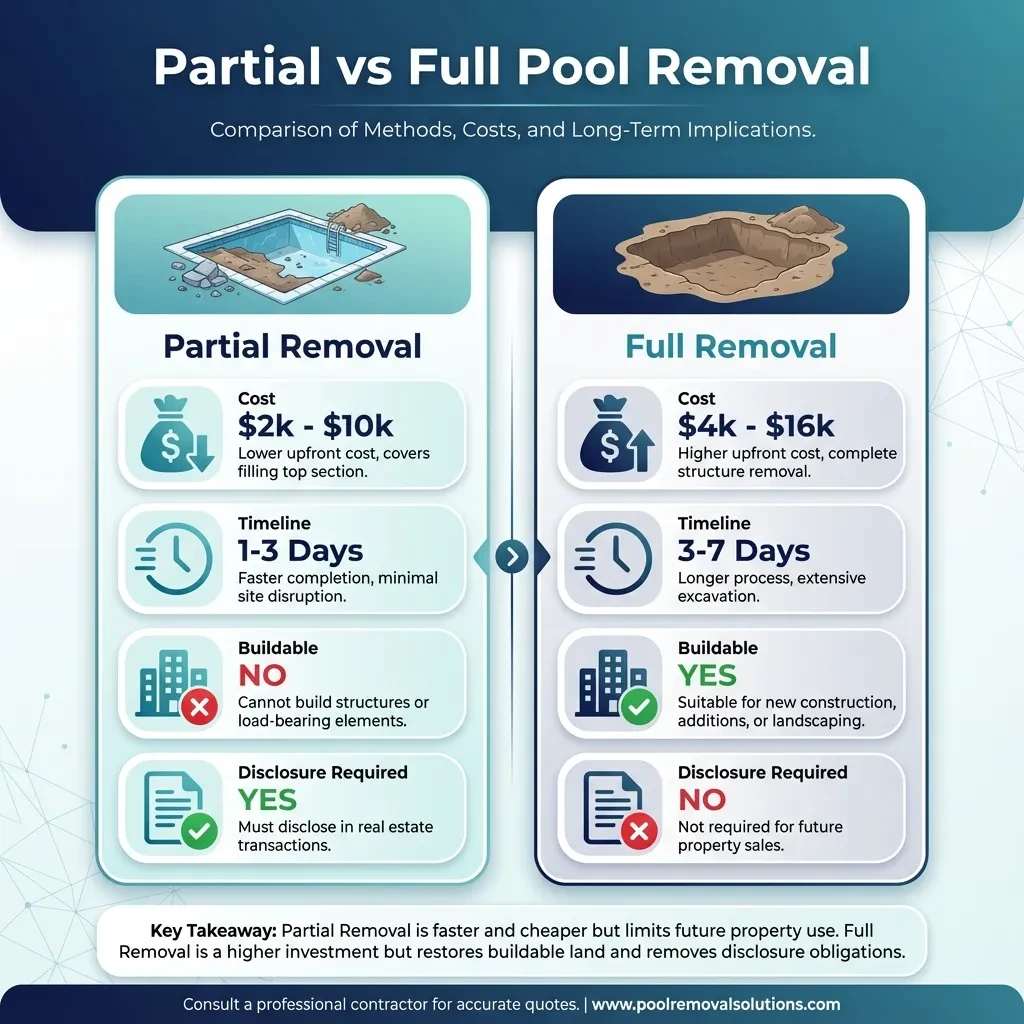
Partial pool removal, also called the fill-in method, involves breaking down only the top portion of your pool structure while leaving the bottom intact. A contractor uses a jackhammer or excavator to demolish the upper 18-24 inches of pool walls, creating manageable rubble that stays on-site. Workers then punch multiple drainage holes through the pool floor to prevent underground water accumulation.
The broken concrete from the demolished walls serves as the first backfill layer, reducing the amount of purchased fill dirt needed by 25-40%. After placing the rubble at the bottom, contractors fill the remaining cavity with clean fill dirt, compacting it in layers. This method typically costs between $2,000 and $10,000, takes 1-3 days to complete, and provides adequate results for homeowners converting the area to lawn or garden space.
However, partial removal creates a non-buildable area permanently. You cannot construct permanent structures like additions, garages, or sheds over a partially removed pool because the buried rubble and incomplete structural removal create an unstable foundation. Local regulations require you to disclose this non-buildable status to future home buyers, which some purchasers view as a negative factor.
What Is Full Pool Removal (Complete Demolition)?
Full pool removal involves completely demolishing and hauling away every component of the pool structure, including the shell, plumbing, electrical systems, and surrounding decking. Professional demolition teams excavate the entire pool cavity, load all debris onto trucks, and transport it to proper disposal facilities or recycling centers.
After clearing all pool materials, contractors fill the cavity with engineered structural fill dirt, compacting each layer to specific density requirements verified through professional testing. This process costs $4,000 to $16,000 depending on pool size and materials, takes 3-7 days minimum, and often requires supervision from a licensed structural engineer to certify the fill work.
Full removal delivers a completely buildable area that functions exactly like undisturbed ground. You can construct any permanent structure on this space without restrictions, and you're not required to disclose the pool's prior existence to future buyers. This method provides maximum future flexibility and typically maintains or increases property value better than partial removal.
How to Calculate Fill Dirt for Pool Removal (Manual Method)
Basic Pool Volume Formula by Shape
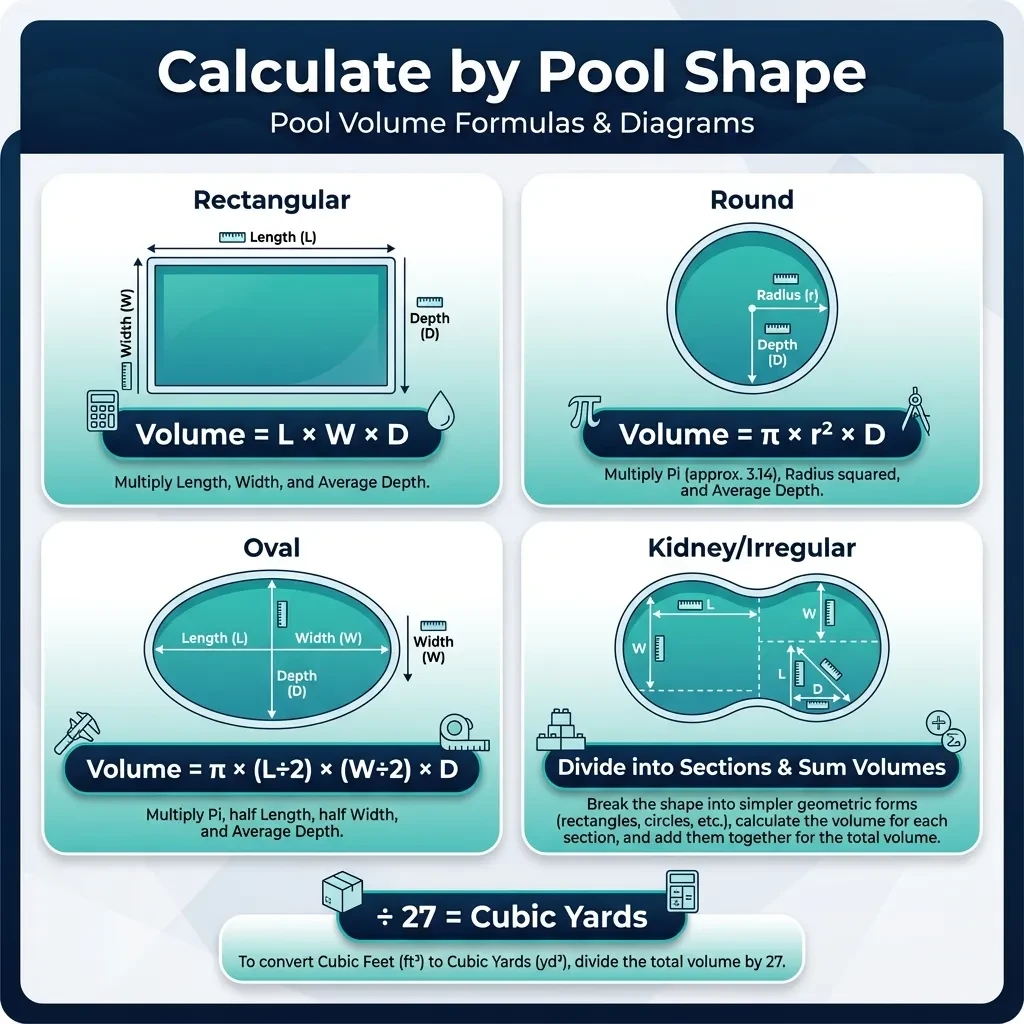
The straightforward formula for rectangular and square pools multiplies length times width times average depth to get cubic feet. Convert to cubic yards by dividing your result by 27, since one cubic yard equals a 3-foot cube (3 × 3 × 3 = 27 cubic feet).
Rectangular Pools Example:
30 ft × 15 ft × 5 ft = 2,250 cubic feet
2,250 ÷ 27 = 83.3 cubic yards
Circular pools require the mathematical constant pi (approximately 3.14) multiplied by the radius squared, then multiplied by average depth. Remember that radius equals half the diameter.
Calculating Average Depth
Most residential pools feature sloped bottoms transitioning from shallow to deep ends. Calculate average depth by adding the shallow end measurement plus the deep end measurement, then dividing this sum by two. A pool with a 3-foot shallow end and 8-foot deep end has (3 + 8) ÷ 2 = 5.5 feet average depth.
The Critical Compaction Factor (Don't Skip This!)
Why Fill Dirt Compacts When Filling a Pool
Freshly excavated and delivered fill dirt contains 30-40% void space consisting of air pockets between soil particles. When this loose dirt experiences weight from additional layers above it and mechanical compaction from equipment, these air pockets compress and collapse, causing the material's overall volume to shrink.
Ordering only the final compacted volume you need guarantees a material shortage. If calculations show you need 100 cubic yards of compacted fill, ordering exactly 100 cubic yards of loose fill leaves you with only 85-90 cubic yards after proper compaction. For more on compaction, see our compacted fill dirt calculator.
How Much Extra Dirt to Account for Compaction
Industry-standard compaction rates for pool filling range from 10-15% volume reduction. Apply this factor by multiplying your compacted volume requirement by 1.10 to 1.15 to determine the loose volume you should order.
Compaction Calculation:
Need: 100 cubic yards compacted
Order: 100 × 1.15 = 115 cubic yards loose material
Topsoil Requirements: The Top 20% Rule
Why You Need Topsoil on Top of Fill Dirt
Fill dirt consists primarily of inert mineral material from deep subsoil excavations. It lacks the organic matter, beneficial microorganisms, and essential nutrients that support healthy plant growth. Quality topsoil contains decomposed organic matter, living soil biology, proper drainage characteristics, and natural fertility that enables robust grass establishment.
The standard recommendation calls for making the top 20-25% of your total fill depth consist of quality topsoil. This depth provides adequate root zone space for grass and most garden plants' root systems, ensuring long-term landscape success.
Calculating Topsoil Quantity
Calculate topsoil requirements by multiplying your total cubic yards by 0.20 (for 20%). A project needing 100 total cubic yards requires 100 × 0.20 = 20 cubic yards of topsoil for the final layer. Order the remaining 80% (80 cubic yards) as economical fill dirt for structural backfilling.
Pool Dirt Fill Calculator: Cost Estimation Guide
Fill Dirt Pricing by Cubic Yard
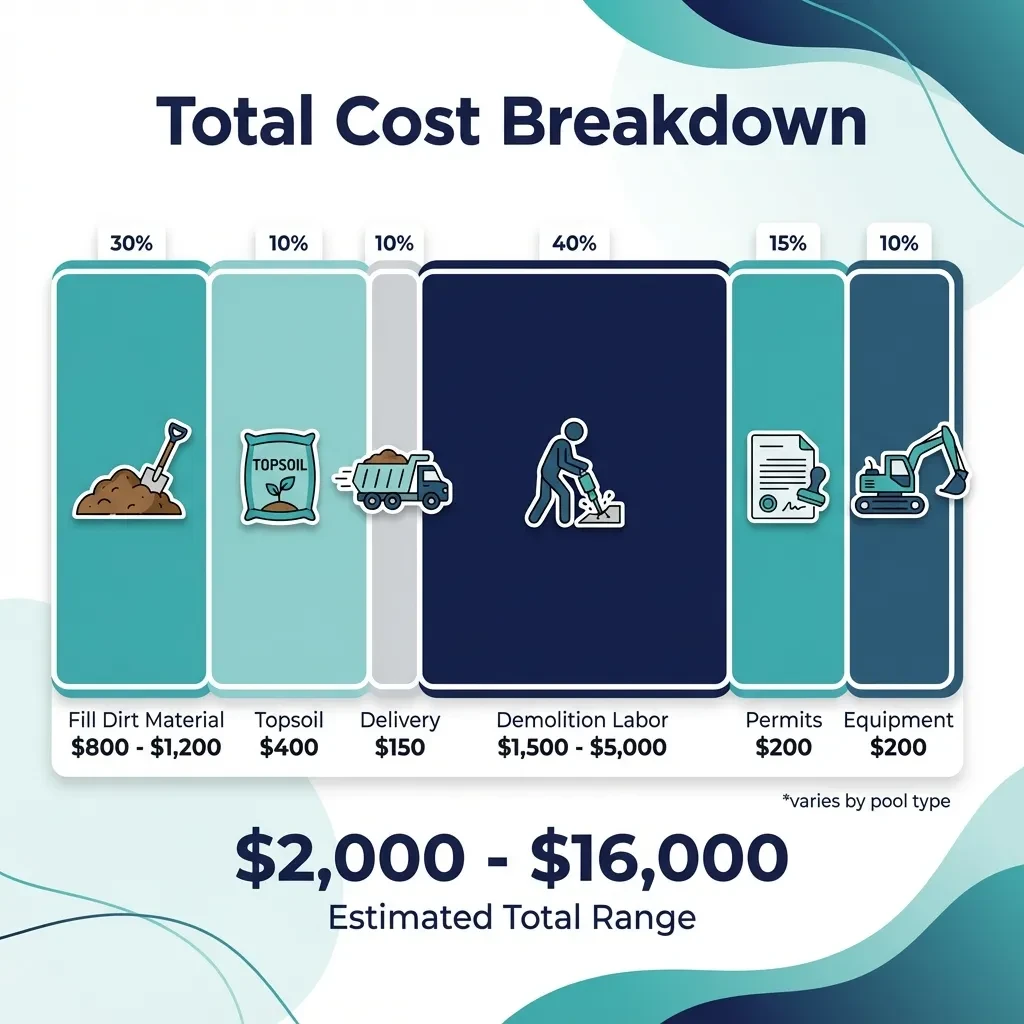
Clean fill dirt from reputable suppliers typically ranges from $8 to $15 per cubic yard depending on your geographic region. Structural fill dirt specified for engineering applications costs $10 to $20 per cubic yard.
Total Cost Breakdown Example
30ft × 15ft × 5ft Pool (Full Removal):
- Fill dirt (76.6 yards @ $12): $919
- Topsoil (19.2 yards @ $25): $480
- Delivery: $100
- Total Material Cost: $1,499
How to Measure Your Pool for Accurate Calculation
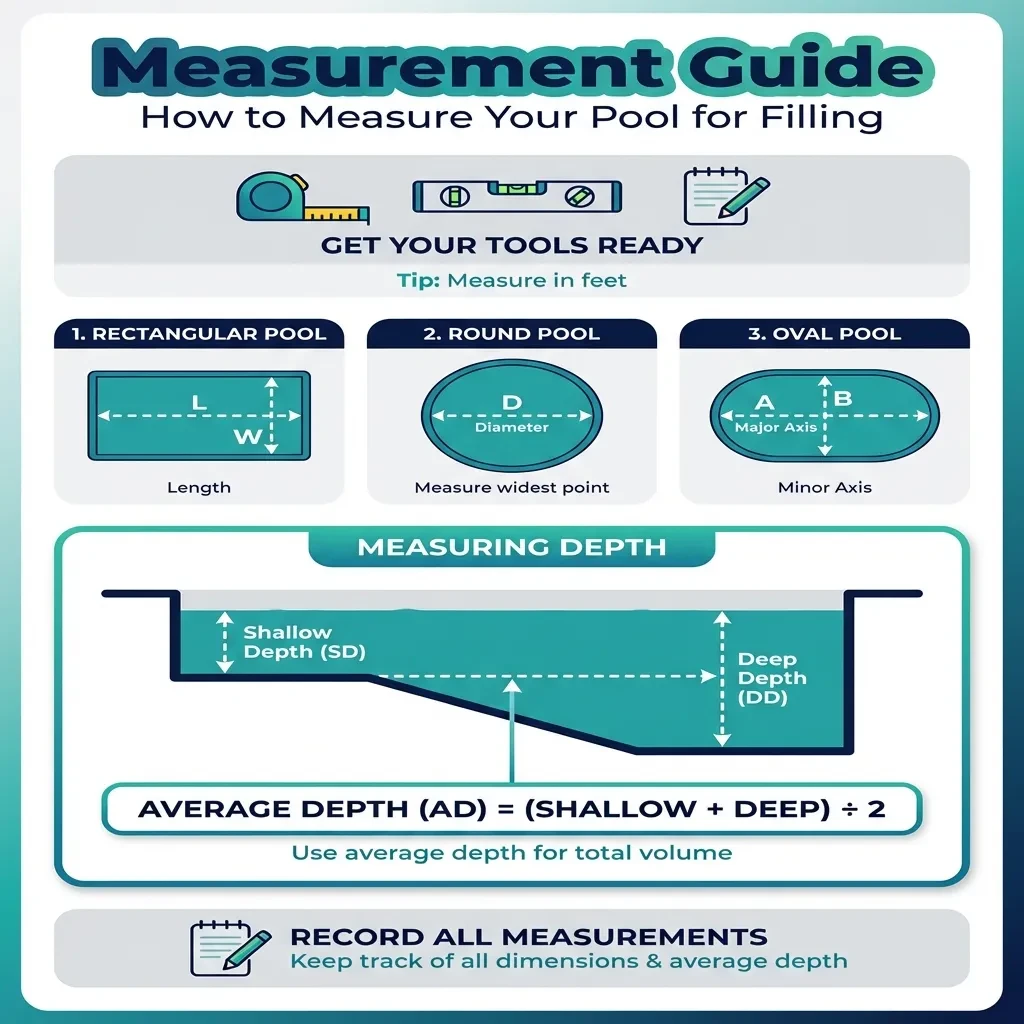
Tools You'll Need
- 50-100 foot measuring tape
- Notepad and pen for recording
- Calculator or smartphone
- Level for checking grade
Measuring Rectangular/Square Pools
Measure your pool's length along the longest straight side from one end to the other. Measure width along the shortest straight side perpendicular to the length. At the shallow end, measure from water surface straight down to the pool floor. Walk to the opposite deep end and repeat the measurement.
Step-by-Step Pool Filling Process
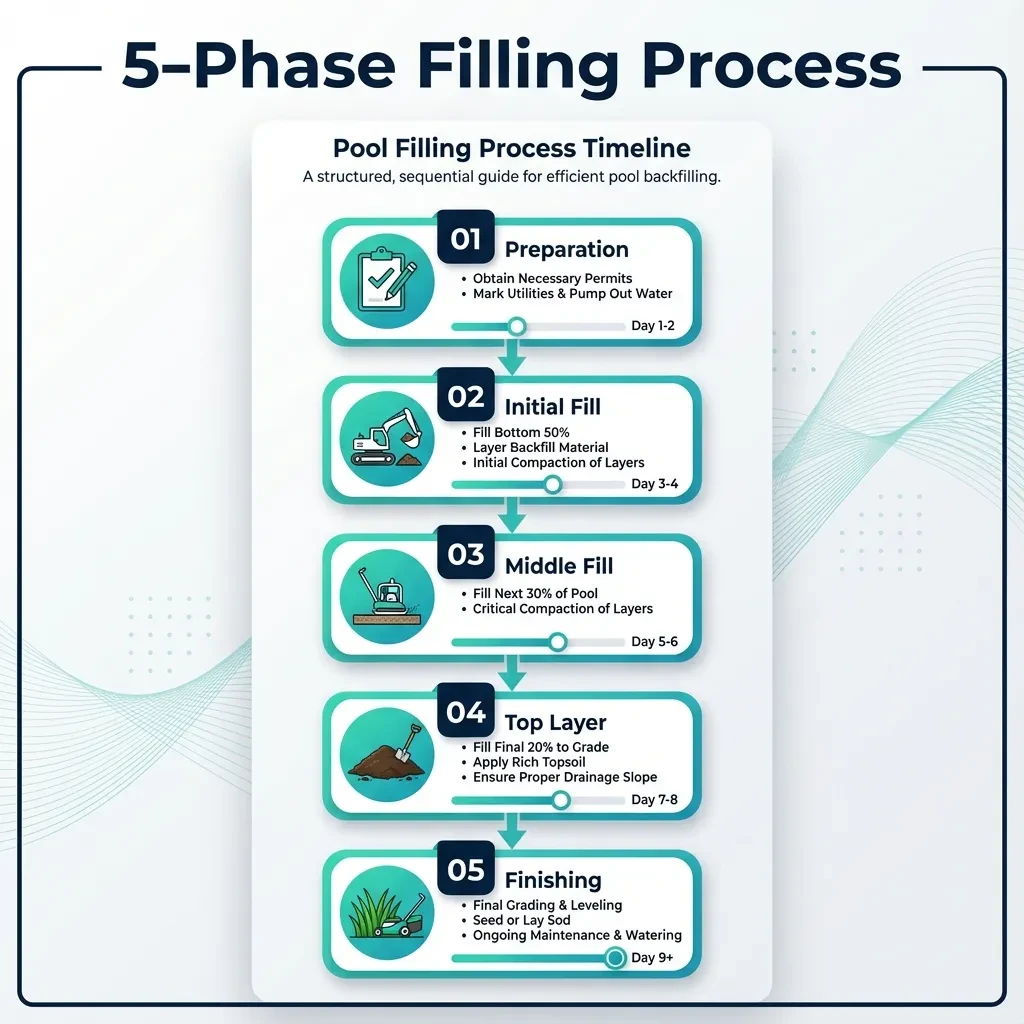
Phase 1: Preparation
Begin by contacting your local building department to determine permit requirements. Call 811 for utility location services. Pump out all water from the pool using a submersible pump.
Phase 2: Initial Fill (Bottom 50%)
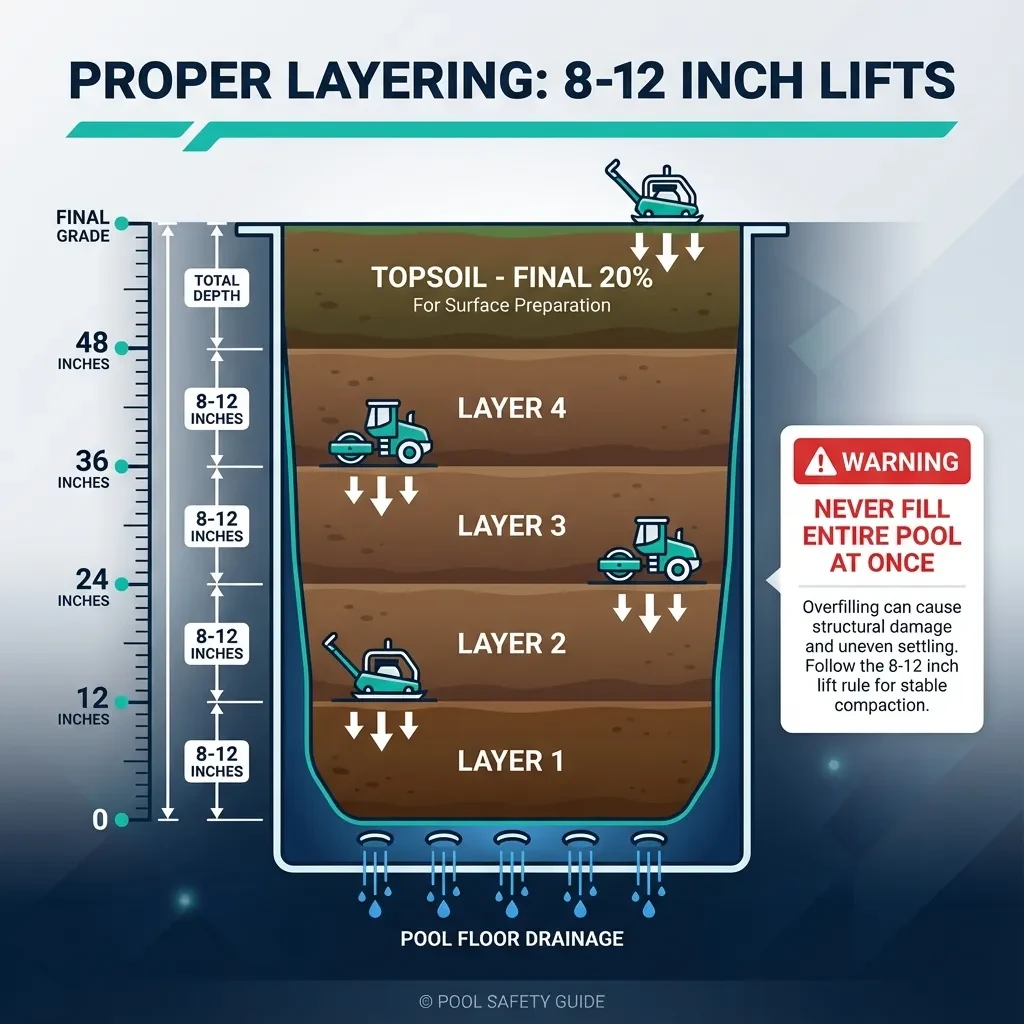
Begin filling with the first 8-12 inch lift of clean fill dirt. Spread material evenly across the entire pool bottom. Compact this first lift thoroughly using a plate compactor, making multiple overlapping passes.
Phase 4: Top Layer (Final 20% - Topsoil)
When fill dirt reaches within 18-24 inches of final grade, switch to quality topsoil for the finishing layer. Spread topsoil evenly in a continuous layer covering the entire filled area. Grade the topsoil surface creating a 2-3% slope directing water away from buildings.
Permit Requirements and Building Codes
Do I Need a Permit to Fill in My Pool?
Most municipalities require building permits for both partial and full pool removal. Permit costs vary from $100 to $500 depending on jurisdiction. Operating without required permits creates numerous risks including stop work orders, fines, and disclosure obligations affecting future property sales.
Common Mistakes When Filling a Pool
Not Accounting for Compaction
Ordering only compacted volume leaves you 10-15% short
Skipping Topsoil Layer
Grass won't grow on fill dirt alone
Improper Compaction
Dumping without layering causes 15-30% settling
Wrong Material Selection
Contaminated fill creates chronic problems
Skipping Permits
Creates legal and disclosure issues
Blocking Drainage
No drainage holes causes foundation damage
Explore More Calculators
Planning other dirt projects beyond pool removal? FillDirtCalculator offers specialized calculators for every fill dirt application:
- Fill Dirt Calculator (Homepage) - General purpose cubic yard calculator
- All Calculators - Browse our complete collection
- Compacted Fill Dirt Calculator - Calculate with compaction factors
- Fill Dirt Cost Calculator - Estimate project costs
Frequently Asked Questions
How many cubic yards of dirt do I need to fill my swimming pool?
Fill requirements depend on pool dimensions and removal method. An average 30-foot by 15-foot pool with 5-foot depth requires approximately 83 cubic yards compacted, but order 95-100 cubic yards to account for 10-15% compaction. Partial removal reduces requirements 25-40%.
What is the difference between fill dirt and topsoil for pool removal?
Fill dirt is inexpensive subsoil from excavations used for structural backfilling that won't decompose. Topsoil is nutrient-rich surface soil supporting plant growth, costing $15-$50 per yard versus $8-$15 for fill dirt. Use fill dirt for bottom 75-80%, topsoil for final 18-24 inches only.
How much does it cost to fill an inground pool with dirt?
Material costs alone range from $1,000 to $6,000 depending on pool size. Total project costs including demolition range from $2,000 to $10,000 for partial removal and $4,000 to $25,000 for full removal depending on pool size, materials, and engineering requirements.
Can I fill my pool myself or do I need a contractor?
Above-ground pools suit DIY approaches since they involve modest fill volumes and simple disassembly. Inground pools demand professional contractors possessing heavy demolition equipment, compaction machinery, permit expertise, insurance coverage, and experience preventing expensive mistakes.
Will my filled pool settle over time?
Properly compacted fills using systematic 8-12 inch layering settle minimally at 1-3% over the first year. Poorly compacted fills dumped carelessly without layering settle dramatically at 10-30%, creating depressions, tripping hazards, and drainage problems requiring expensive remediation.
Do I need a permit to fill in my swimming pool?
Most municipalities require building permits for both partial and full pool removal, with costs ranging from $100 to $500. Operating without required permits risks stop-work orders, fines, forced removal of completed work, and title complications during future property sales.
Should I do partial or full pool removal?
Partial removal costs $2,000-$10,000, completes in 1-3 days, but creates non-buildable areas requiring disclosure. Full removal costs $4,000-$16,000+, takes 3-7 days, requires engineering, but delivers buildable areas without disclosure requirements providing maximum future flexibility.
How long does it take to fill a pool with dirt?
Partial removal including demolition, filling, and compaction typically requires 1-3 days. Full removal extends to 3-7 days minimum including complete demolition, debris removal, systematic fill placement, comprehensive compaction, and final grading. Professional contractors complete work substantially faster than DIY approaches.
What type of dirt should I use to fill my pool?
Use clean fill dirt free from organic matter, construction debris, toxic contaminants, and excessive clay for structural backfilling. For full removals requiring engineering certification, purchase structural fill meeting specific gradation standards. Reserve quality screened topsoil exclusively for the final 18-24 inch layer supporting lawn growth.
How thick should each layer be when filling a pool?
Maximum lift thickness is 8-12 inches of loose material before compaction. Thicker layers prevent compaction equipment from adequately densifying the entire depth, leaving soft lower portions that settle over time. Spread each lift evenly, compact thoroughly, then add the next layer.
Can I put a structure on my filled pool area?
Partial removal creates non-buildable areas permanently unable to support permanent structures due to buried rubble and incomplete structural removal. Full removal with engineered fill certified by engineers creates genuinely buildable areas supporting structures identically to undisturbed ground after proper compaction testing.
Why do I need drainage holes in the bottom of the pool?
Without drainage holes, your filled pool becomes an underground pond collecting groundwater and surface runoff. Trapped water exerts hydrostatic pressure against nearby foundations causing cracks, basement leaks, and ground instability. Multiple drainage holes allow collected water to drain naturally into surrounding soil.
Will filling my pool increase or decrease property value?
Market-dependent effects vary by location and buyer demographics. Families with young children sometimes prefer properties without pools, viewing them as safety hazards. Properly executed full removals harm values least since buyers maintain flexibility. Partial removals requiring disclosure potentially decrease values more.
How much topsoil do I need after filling with dirt?
Industry standard recommends the top 20-25% of total fill depth consist of quality topsoil enabling grass establishment. For a project requiring 100 cubic yards total, calculate 100 × 0.20 = 20 cubic yards of topsoil for the final layer. Order the remaining 80 cubic yards as economical fill dirt.
What happens if I order the wrong amount of fill dirt?
Ordering too little requires emergency additional deliveries mid-project at rush rates, often paying premium prices for small loads. Delivery fees for second loads equal or exceed first deliveries. Ordering excessive amounts creates disposal problems. Use the pool dirt fill calculator with compaction factors to order correctly the first time.