Fill Dirt Calculator Circle
Calculate fill dirt for circular areas. Eliminate diameter/radius confusion, get cost estimates, and find practical guidance for tree rings, pools, patios, and gardens.
By Todd Bly, B.S. Construction Management · Updated October 2026
Pro Fill Dirt Calculator
Accurate estimates for Yards, Tons, & Compaction
Results
How to Calculate Fill Dirt Calculator Circle
The Formula
Volume = π (3.14159) × radius² × depth (in feet), then divide by 27 for cubic yards. Add 15-20% for circular compaction challenges. Accepts diameter OR radius input.
Measure Accurately
Measure in feet. For depth, measure in inches and our tool handles the conversion (divide by 12).
Check Your Shape
Most fill dirt calculator circle projects are circles. If irregular, break it into smaller shapes.
Add Compaction
Diameter/radius confusion affects 50%+ of circular calculations, creating 4× volume errors costing $360+ on typical projects. Circular areas need 15-20% compaction buffer vs 10-15% for rectangles due to edge access difficulties. First dedicated circular calculator with cost transparency.
Calculating fill dirt for circular projects presents unique challenges not found in rectangular areas. Whether you're planning a tree ring around your oak tree, preparing a level base for a 24-foot above-ground pool, creating a circular patio for outdoor entertaining, or building raised round garden beds, accurate volume calculations prevent costly material ordering mistakes.
Our fill dirt calculator circle tool eliminates the most common error that affects over half of circular project calculations: diameter versus radius confusion. This dedicated calculator accepts either measurement and automatically converts to the proper format, ensuring you order the right amount of fill dirt the first time.
What Is a Circular Fill Dirt Calculator and When Do You Need It?
Definition and Purpose
A circular fill dirt calculator determines the volume of fill material needed for round or circular areas using the cylinder volume formula. Unlike generic volume calculators that handle multiple shapes with equal weight, this specialized tool optimizes specifically for circular projects where diameter and radius measurements create frequent user confusion.
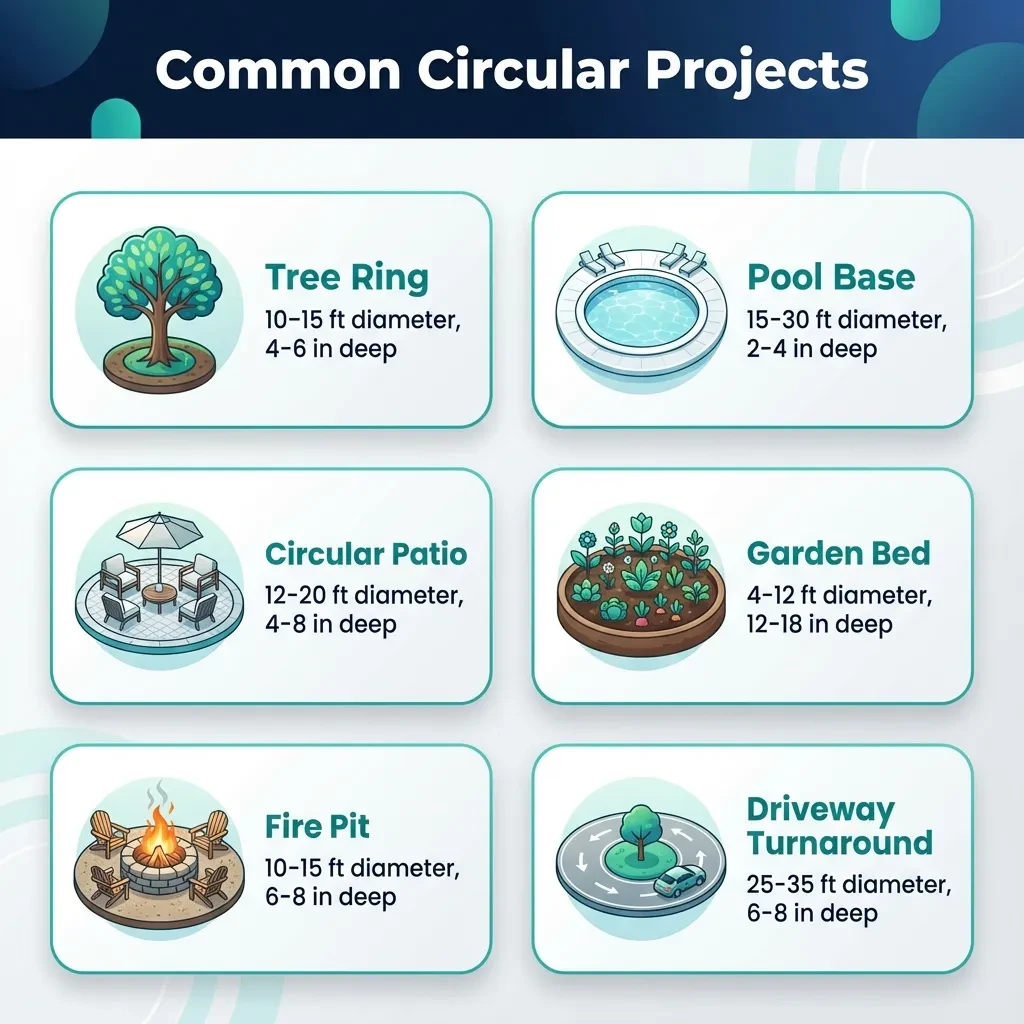
The calculator converts measurements to cubic yards, the industry standard for fill dirt purchasing and delivery truck capacity. Common circular applications include tree planting rings (10-15 feet diameter, 4-8 inches deep), above-ground pool leveling bases (15-30 feet diameter, 2-4 inches sand), circular patios and fire pits (8-20 feet diameter, 4-8 inches gravel base), round raised garden beds (4-12 feet diameter, 12-18 inches soil), and circular driveway turnarounds (25-35 feet diameter, 6-8 inches road base).
Diameter vs Radius: Understanding Circle Measurements
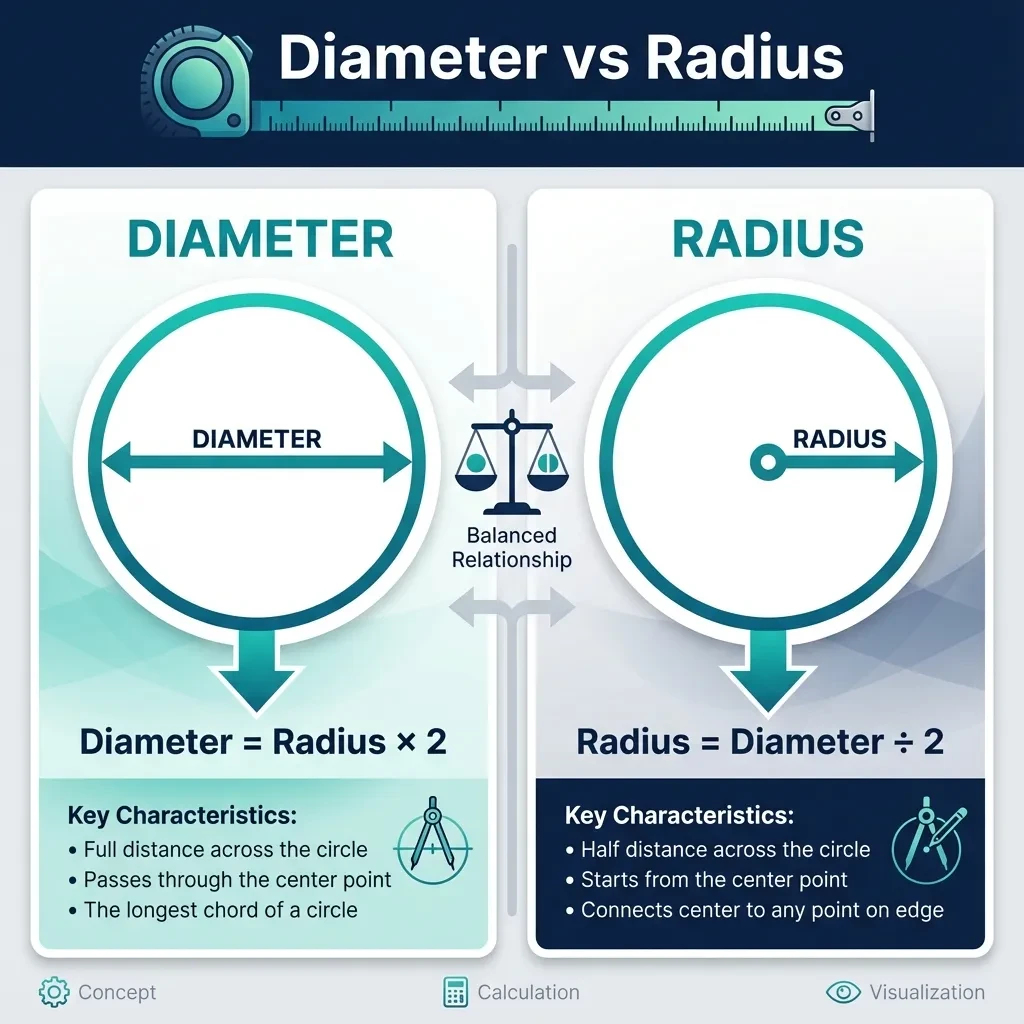
What Is Diameter?
Diameter represents the full distance across a circle measured through its center point from one edge to the opposite edge. The formula relationship between diameter and radius follows a simple 2:1 ratio: Diameter equals radius multiplied by two. For example, a 20-foot diameter above-ground pool equals exactly 20 feet across at its widest measurement through the center.
What Is Radius?
Radius measures the distance from the exact center point of a circle to any point on its edge or perimeter. The formula relationship: Radius equals diameter divided by two. For example, a 20-foot diameter circular patio has a 10-foot radius (20 feet ÷ 2 = 10 feet). Radius serves as the critical measurement because the cylinder formula uses radius squared, not diameter.
Why This Matters for Calculations
The most common error involves using diameter when the formula requires radius. This mistake affects over 50% of DIY circular calculations. If you accidentally input diameter (20 feet) when the calculator expects radius, the formula calculates volume as if radius were 20 feet instead of the actual 10 feet. Since the formula squares the radius, this error creates exactly 4 times the correct volume. For a project requiring 4 cubic yards at $30 per yard ($120), diameter-radius confusion causes you to order 16 cubic yards ($480), wasting $360.
How to Use the Fill Dirt Calculator Circle
Step 1: Choose radius or diameter input based on which measurement you took. Most homeowners find diameter easier to measure. Step 2: Enter your circle dimension in feet (accepts decimals like 12.5 feet). Step 3: Input desired depth in inches or feet. Typical depths: tree rings 4-6 inches, pool bases 2-4 inches, patios 4-8 inches, garden beds 12-18 inches. Step 4: Review the cubic yards result and add 15-20% compaction buffer for circular areas (versus 10-15% for rectangles) due to edge compaction difficulties.
Fill Dirt Formula for Circular Areas
The Basic Formula
Volume (cubic feet) = π × radius² × depth (in feet). Pi (π) equals approximately 3.14159. Radius squared means radius multiplied by itself. Depth must be in feet (convert inches by dividing by 12). Result produces cubic feet.
Converting to Cubic Yards
Divide cubic feet by 27 to get cubic yards (1 cubic yard = 3×3×3 = 27 cubic feet). Fill dirt sells in cubic yards. Example: 15-foot circular patio (7.5-foot radius) with 6-inch depth (0.5 feet): 3.14159 × 7.5² × 0.5 = 88.36 cubic feet ÷ 27 = 3.27 cubic yards. Add 15% compaction: 3.27 × 1.15 = 3.76 cubic yards. Order 4 cubic yards.
Circular Fill Dirt Project Examples
10-Foot Tree Ring (4 inches deep)
Materials: 1.1 cubic yards topsoil. Cost: $130-200 including delivery. DIY rating: Excellent. Calculation: 10-ft diameter = 5-ft radius. Volume: 3.14159 × 5² × 0.33 = 25.92 cu ft ÷ 27 = 0.96 cu yds + 15% = 1.1 cu yds.
24-Foot Pool Base (3 inches sand)
Materials: 4.6 cubic yards masonry sand. Cost: $270-385. DIY rating: Moderate (requires precision leveling). Calculation: 24-ft diameter = 12-ft radius. Volume: 3.14159 × 12² × 0.25 = 113.1 cu ft ÷ 27 = 4.19 cu yds + 10% = 4.6 cu yds.
15-Foot Patio (6 inches base)
Materials: 4 cubic yards crushed gravel. Cost: $332-442 DIY, $532-842 professional. Calculation: 15-ft diameter = 7.5-ft radius. Volume: 3.14159 × 7.5² × 0.5 = 88.36 cu ft ÷ 27 = 3.27 cu yds + 15% = 3.76 cu yds, order 4.
How to Measure Circular Areas
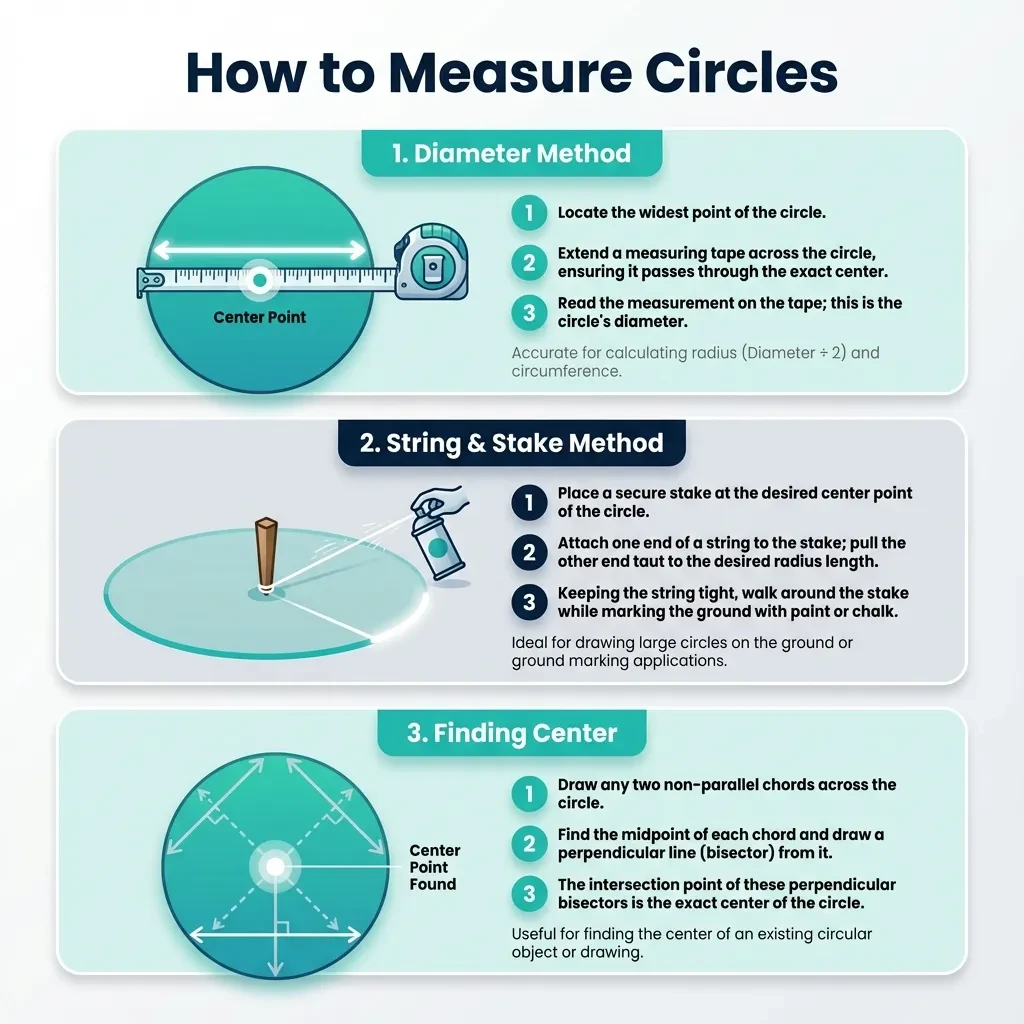
For existing circles, measure diameter by stretching tape across widest point through center. For new circles, use string and stake method: drive stake at center, tie string equal to desired radius, walk around stake keeping string taut, mark ground every 2-3 feet. For irregular circles, measure diameter at 3-4 different angles and average results.
Compaction for Circular Areas
Why Circles Need Extra Attention
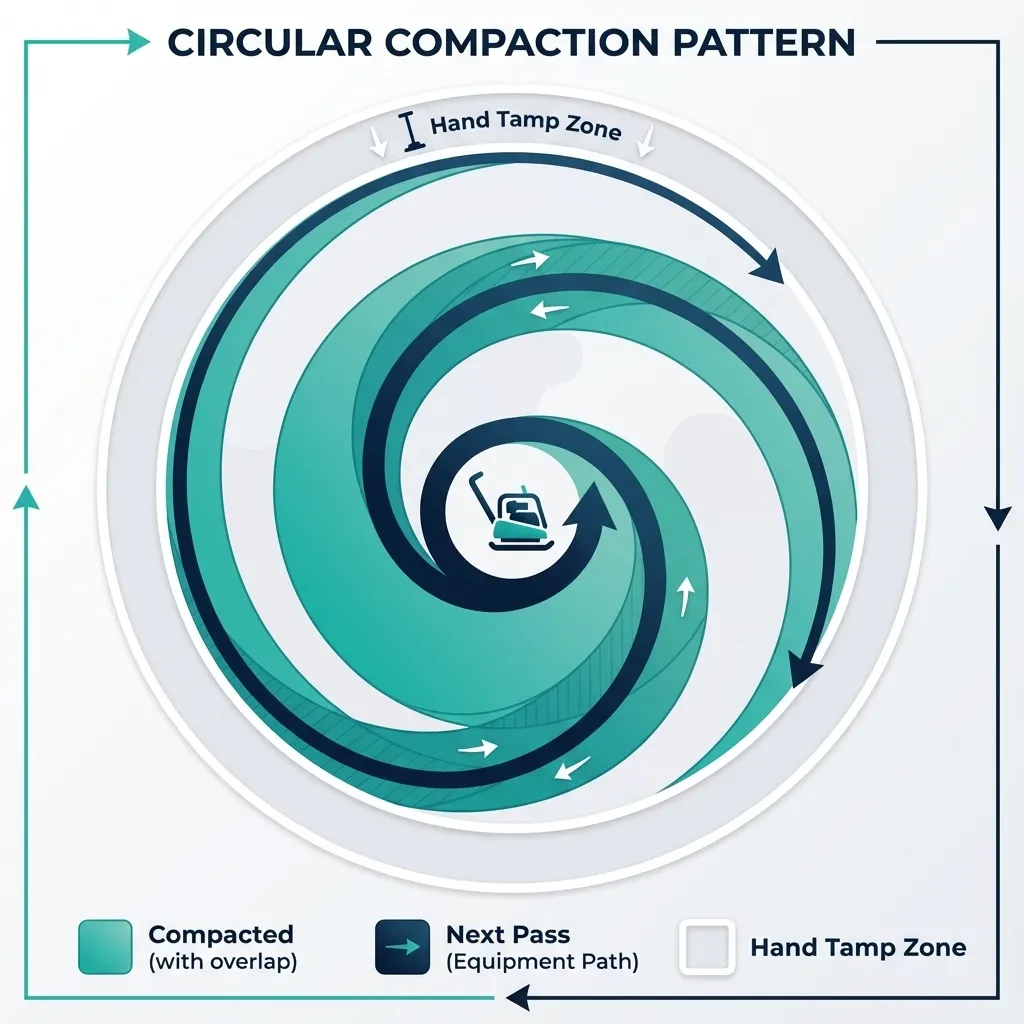
Circular areas require 15-20% compaction buffer versus 10-15% for rectangles due to edge access difficulty. Walk-behind plate compactors work best in straight lines but struggle on curved perimeters. The final 12-18 inches around circle edges often receive poor compaction unless hand-tamped, creating rim depression from differential settling.
Compaction Equipment and Pattern
Use walk-behind plate compactor ($75-150/day rental) working in spiral pattern from center outward with 25-30% overlap between passes. Compact in 3-4 inch lifts maximum. Critically important: hand-tamp the final 12-18 inches around entire perimeter since plate compactor cannot reach curved edges effectively. For circles over 25 feet, consider vibratory roller for center area.
Material Selection
Topsoil ($25-45/yard): Best for tree rings and garden beds, high organic content for plant growth. Masonry sand ($15-35/yard): Optimal for pool bases, smooth surface, minimal compaction, excellent leveling. Crushed gravel ($20-40/yard): Required for patio and driveway bases, excellent compaction, structural support. Common fill dirt ($10-20/yard): General yard grading only, not suitable for structural applications.
Complete Cost Breakdown
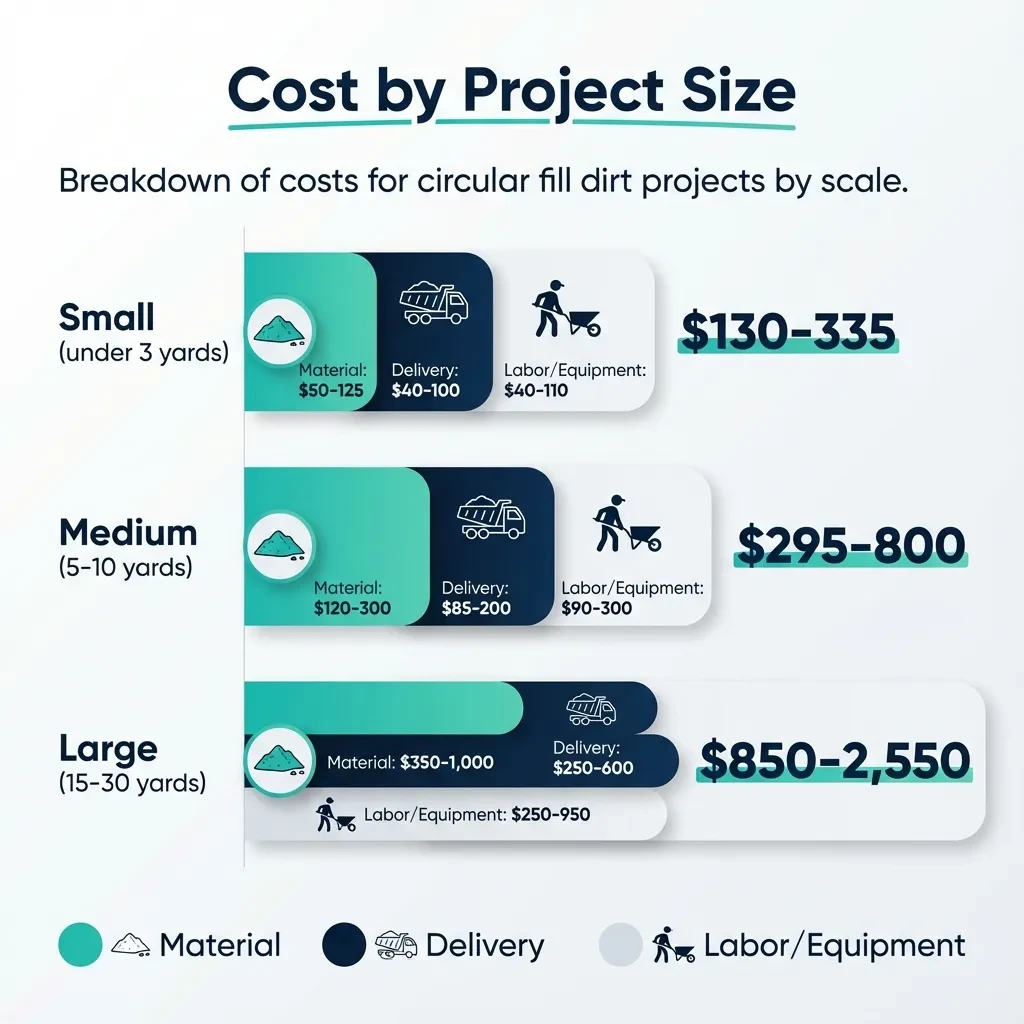
Small projects (under 3 yards): $130-335 total including materials and delivery. Medium projects (5-10 yards): $295-800 total. Large projects (15-30 yards): $850-2,550 total. Add delivery fees of $100-250 for typical loads. Professional installation adds $200-900 labor depending on project complexity and size.
DIY vs Professional Installation
DIY Feasibility
Excellent DIY candidates: Projects under 5 cubic yards, depths under 6 inches, tree rings under 12 feet, garden beds under 10 feet. Moderate DIY: 5-10 cubic yards, 6-12 inch depths, 12-15 foot patios, requires rental compactor. Hire professional for: Pools requiring precise leveling, projects over 15 cubic yards, depths exceeding 18 inches, permit-required work.
Professional Installation Value
Professional installation ($200-900 labor) prevents $500-2,000 mistakes from poor compaction, improper leveling, or material waste. Pros provide guaranteed density, warranty on work (1-3 years typical), permit handling, and insurance coverage. Markup runs 40-60% over materials but justifies through expertise and accountability.
Permit Requirements
Permits typically required for: Total volume exceeding 50 cubic yards, depth over 2-3 feet, work within setback zones (10-20 feet from property lines), projects affecting drainage, structural bases in some jurisdictions. Generally exempt: Small gardens under 3 cubic yards, tree rings under 12 feet diameter, decorative features under 12 inches deep. Costs: $75-300, approval timeline: 2-6 weeks. Always verify with local building department before starting.
8 Common Mistakes to Avoid
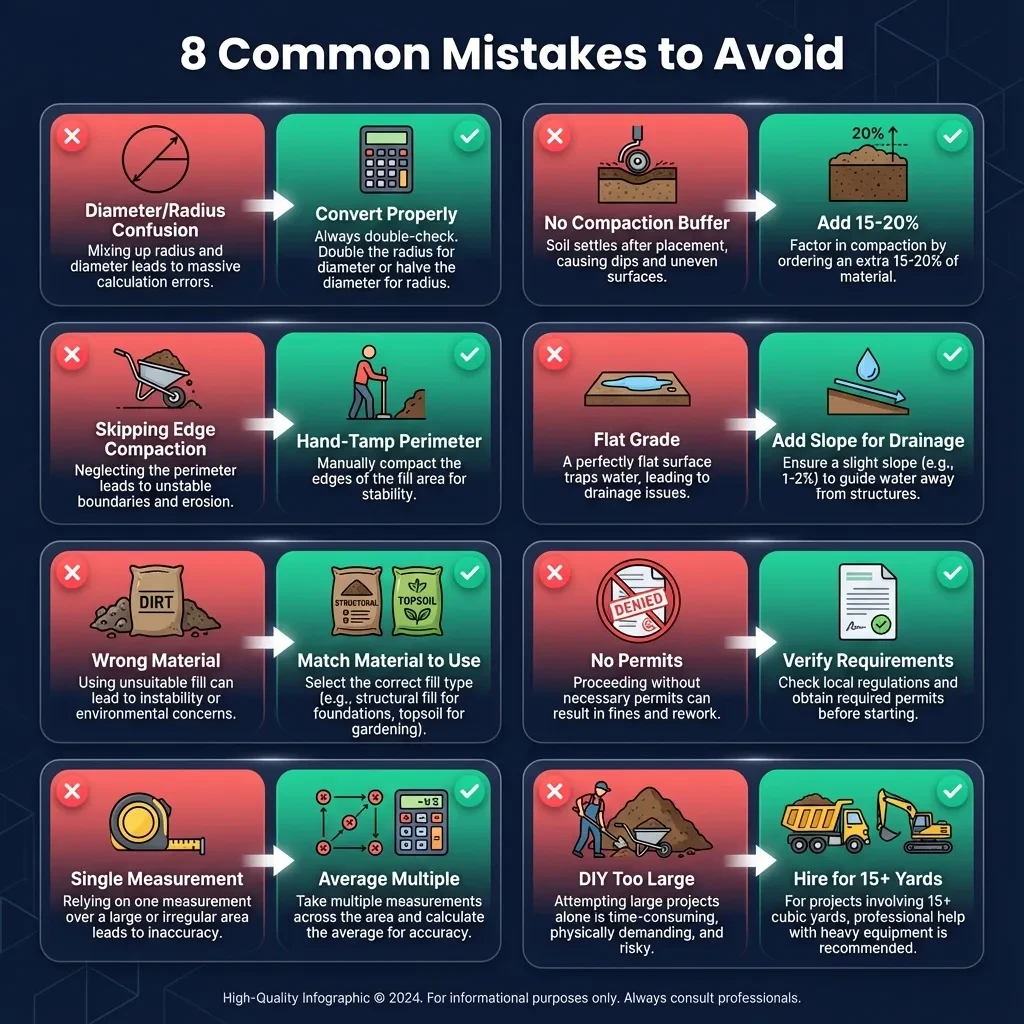
1. Diameter/radius confusion (creates 4× volume error). 2. Not accounting for compaction (leaves project 15-20% short). 3. Skipping edge compaction (causes rim depression). 4. Ignoring drainage slope (creates ponding). 5. Using topsoil for structural bases (organic decomposition causes settling). 6. Measuring irregular circles once (average 3-4 measurements). 7. Skipping permits on large projects (risks fines $500-5,000). 8. DIY on excessive scale (projects over 15 yards need professionals).
Related Fill Dirt Calculators
Planning additional fill dirt projects beyond circles? FillDirtCalculator offers specialized calculators for every application. Our general-purpose calculator on the homepage handles rectangular and irregular shapes. Browse all calculators to explore our complete collection. The compacted fill dirt calculator provides automatic compaction factors for structural applications. The fill dirt cost calculator estimates total project costs including materials, delivery, and labor. The house pad fill dirt calculator specializes in building pad preparation with code requirements.
Conclusion
Calculating fill dirt for circular projects no longer needs to be complicated. This dedicated fill dirt calculator circle tool eliminates diameter versus radius confusion by accepting either measurement and automatically converting to proper format. Understanding that circular areas require 15-20% compaction buffer accounts for edge compaction difficulties inherent to curved geometry. Material selection matching application requirements prevents failures: topsoil for planting, sand for pools, gravel for patios. DIY feasibility assessment helps determine realistic scope, with projects under 10 cubic yards suiting capable homeowners while larger projects benefit from professional installation. Use the calculator above for accurate volume estimates on your circular fill dirt project.
Frequently Asked Questions
How much fill dirt do I need for a circular area?
Calculate using Volume = π × radius² × depth (feet), divide by 27 for cubic yards. Example: 20-ft diameter circle (10-ft radius) with 6-inch depth: 3.14159 × 10² × 0.5 = 157.08 cu ft ÷ 27 = 5.82 cu yds. Add 15-20% for compaction = 6.7-7 cubic yards order.
What's the difference between diameter and radius?
Diameter is full distance across circle through center (edge to edge), radius is half that distance (center to edge). This matters because the formula uses radius squared. Inputting diameter when formula needs radius creates exactly 4× volume error, affecting 50%+ of DIY calculations.
How do I measure a circular area?
For existing circles: tape measure across widest point through center. For new circles: string and stake method (stake at center, string = radius length, walk around marking ground). For irregular circles: measure diameter at 3-4 angles and average.
How much does fill dirt cost for circular projects?
Material costs: common fill $10-20/yard, topsoil $25-45, sand $15-35, gravel $20-40. Add delivery $100-250. Small projects (under 3 yards): $130-335 total. Medium (5-10 yards): $295-800. Large (15-30 yards): $850-2,550. Professional installation adds $200-900 labor.
Can I do a circular fill dirt project myself?
DIY feasible for projects under 5-10 cubic yards with depths under 12 inches (tree rings, small gardens). Need rental plate compactor ($75-150/day), hand tamper, basic tools, 6-12 hours work time. Hire professionals for pools requiring precision leveling, volumes over 15 yards, and permit-required work.
Do circular areas need more fill dirt than rectangles?
Same surface area and depth require identical raw volume. However, circular projects need higher 15-20% compaction buffer vs 10-15% for rectangles because curved edges prove harder to compact with typical rectangular equipment. Mandatory hand-tamping around perimeter compensates for geometric challenges.
What compaction factor for circular projects?
Add 15-20% to calculated volume for circular areas accounting for material settling (10-15%) plus difficulty reaching adequate compaction at curved edges (3-5% extra). For critical applications like pools or patios, use full 20% buffer. Compact in 3-4 inch lifts with mandatory hand-tamping around complete perimeter.
Best fill material for above-ground pools?
Masonry sand or fine screening provides optimal pool base: excellent leveling (achieves ±1 inch tolerance), smooth surface preventing liner punctures, good drainage, minimal shifting. Use 2-4 inches depth. Avoid topsoil (organic content), pea gravel (too coarse), and clay-heavy fill (poor drainage).
How deep should fill dirt be for circular patio?
Circular patios require 4-8 inches compacted gravel base depending on surface material. For pavers: 4-6 inch gravel + 1 inch sand + pavers. For flagstone: 6-8 inch gravel + 1-2 inch sand + stone. Base should extend 6-12 inches beyond circle perimeter for edge support and drainage.
How accurate is a circular fill dirt calculator?
Online calculators provide ±5-10% accuracy when measurements are correct. Cylinder volume formula is mathematically precise, but real-world accuracy depends on measurement precision, circle regularity, depth consistency, and proper conversions. Sufficient for material ordering when combined with 15-20% compaction buffer.
Do circular fill projects require permits?
Requirements vary but generally trigger for: volume exceeding 50 cubic yards, depth over 2-3 feet, work within setbacks (10-20 feet from property lines), affecting drainage. Small gardens under 3 yards usually exempt. Permits cost $75-300 with 2-6 week approval. Always verify with local building department.
Can I calculate fill dirt for irregular circular areas?
Yes, by averaging multiple diameter measurements. Measure diameter at 3-4 different angles, calculate average, use for volume calculation. For highly irregular shapes, divide into smaller circular or rectangular sections, calculate separately, then sum. Provides ±10-15% accuracy sufficient for ordering with appropriate buffer.
Is calculation the same for all circular projects?
Basic volume formula identical (π × radius² × depth) but material selection, compaction requirements, and depth vary dramatically. Tree rings need topsoil (4-6 inches), pools require sand (2-4 inches), patios need gravel (4-8 inches), gardens use quality soil (12-18 inches). Each demands different standards.
Best way to compact circular fill dirt?
Walk-behind plate compactor in spiral pattern from center outward with 25-30% overlap. Compact in 3-4 inch lifts with slightly damp material. Critically: hand-tamp final 12-18 inches around entire perimeter since plate compactor cannot reach curved edges. For large circles over 25 feet, use vibratory roller for center.
How many dump truck loads for circular project?
Standard trucks carry 10-15 cubic yards. Divide total volume including compaction buffer by truck capacity. Example: 25-yard project + 15% = 28.75 yards ÷ 12 yards/truck = 2-3 truckloads. Many suppliers have 5-7 yard minimums with surcharges for smaller loads. Coordinate sequential delivery for residential driveways.