Fill Dirt Calculator by Square Feet: Sq Ft to Yards
Calculate cubic feet needed to fill dirt based on square footage. Instant conversions from area to volume for precise ordering.
By Todd Bly, B.S. Construction Management · Updated October 2026
Pro Fill Dirt Calculator
Accurate estimates for Yards, Tons, & Compaction
Results
How to Calculate Fill Dirt Calculator by Square Feet: Sq Ft to Yards
The Formula
To calculate cubic feet of fill dirt from square footage, multiply your area (length × width) by depth in feet. For example, 300 square feet at 6 inches deep: 300 × 0.5 ft = 150 cubic feet. Our tool handles all conversions automatically.
Measure Accurately
Measure in feet. For depth, measure in inches and our tool handles the conversion (divide by 12).
Check Your Shape
Most fill dirt calculator by square feet: sq ft to yards projects are areas. If irregular, break it into smaller shapes.
Add Compaction
Understanding how to calculate square footage accurately is the foundation of every fill dirt project. Small measurement errors multiply quickly, leading to costly over-ordering or project-stopping shortages.
📖 Table of Contents
Fill Dirt Calculator Square Feet: The Complete Guide
Ever found yourself standing in your yard, tape measure in hand, trying to figure out how to calculate square footage for fill dirt? You're not alone! This is hands-down one of the most common questions we get from homeowners and DIYers.
Here's the thing: most people think calculating fill dirt is all about cubic yards, but the reality is that square footage is actually the starting point for every single calculation. Whether you're leveling a bumpy lawn, building a patio base, or filling in low spots, understanding how to work with square feet is absolutely crucial.
The $400 Square Footage Mistake
Last month, a neighbor of mine tried to "guesstimate" the square footage for his 30×20 yard leveling project. He figured "it's about 500 square feet or so" without actually measuring. Turns out it was 600 square feet. That seemingly small 100 square foot difference? At 6 inches deep, that's an extra 50 cubic feet – nearly 2 cubic yards – which cost him an unexpected $350 in materials and another delivery fee. Ouch!
But don't worry! This comprehensive guide will show you exactly how to calculate cubic feet of fill dirt per square foot, avoid expensive mistakes, and use our free fill dirt calculator square feet tool to get instant, accurate results. For easy conversion to cubic yards, check our cubic yards calculator.
By the end of this guide, you'll understand not just the formulas, but the why behind them. You'll be able to measure like a pro, convert confidently, and order the exact amount of fill dirt you need – no more, no less.
What is Square Footage? (And Why Does It Matter for Fill Dirt?)
Let's start with the absolute basics. Square footage is simply a measurement of area – specifically, the two-dimensional space that your project covers. Think of it as looking down from a drone: square footage tells you how much ground you're covering, but it doesn't say anything about depth yet.
📏 In Simple Terms
One square foot is literally a square that measures 1 foot on each side. Easy, right?
1 ft × 1 ft = 1 square foot
🎯 For Your Project
If your yard area is 20 feet long and 15 feet wide, you're looking at 300 square feet of coverage. That's your starting point for calculating cubic feet needed for fill dirt.
Why Square Feet First, Then Cubic Feet?
Here's where people get confused. You might be thinking, "Wait, don't I need cubic measurements for fill dirt?" Yes! But here's the secret that professionals know:
💡 The Two-Step Reality
- 1.First, you measure the area in square feet (length × width)
- 2.Then, you multiply by depth to get volume in cubic feet
Think of it like baking: square footage is the size of your pan, depth is how full you fill it!
This is why understanding how to calculate square footage for fill dirt is step #1. You can't skip it! Every calculation, every order, every budget estimate starts with getting your square footage right.
Why Accurate Square Footage Calculations Matter
Getting your square footage wrong leads to one of two painful outcomes: running short mid-project or wasting money on excess material.
⚠️ Under-Estimating Square Feet
- •Project delays waiting for second delivery
- •Second delivery fee: $150-$250
- •Premium pricing for small top-up orders
💸 Over-Estimating Square Feet
- •Paying for material you don't need
- •Leftover dirt pile to remove
- •Potential disposal costs
How to Calculate Square Feet for Fill Dirt
Measuring Square Feet: Essential Tools
Tape Measure (50-100ft)
Your primary tool. Get a quality one that's long enough for your project.
Smartphone/Notepad
Document every measurement immediately. Take photos!
Stakes & String
For irregular areas, mark corners and run string for clear boundaries.
Rectangle Formula
Square Feet = Length (ft) × Width (ft)Circle Formula
Square Feet = 3.14 × (Radius)²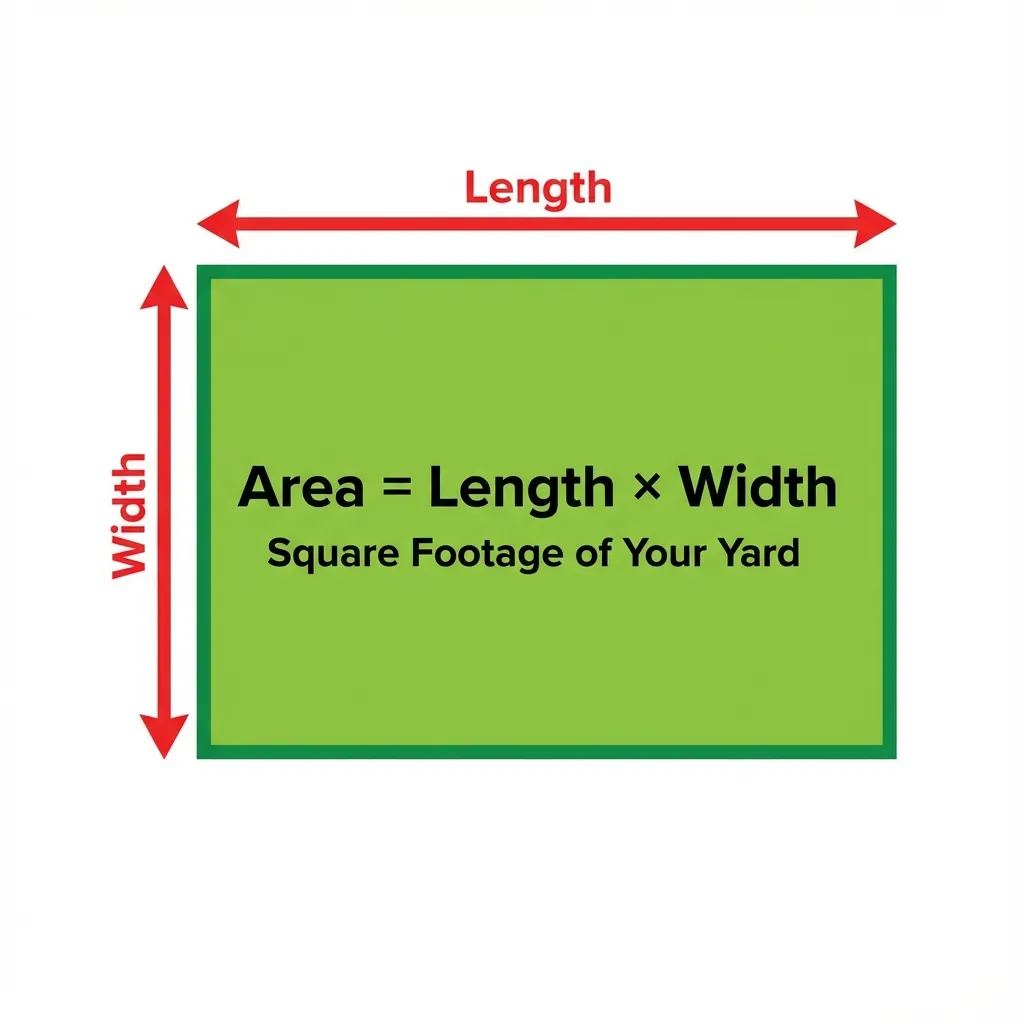
Visual guide to measuring your project area
Converting Square Feet to Cubic Feet
The Universal Conversion Formula
Cubic Feet = Square Feet × Depth (in feet)Critical: Depth MUST be in feet, not inches!
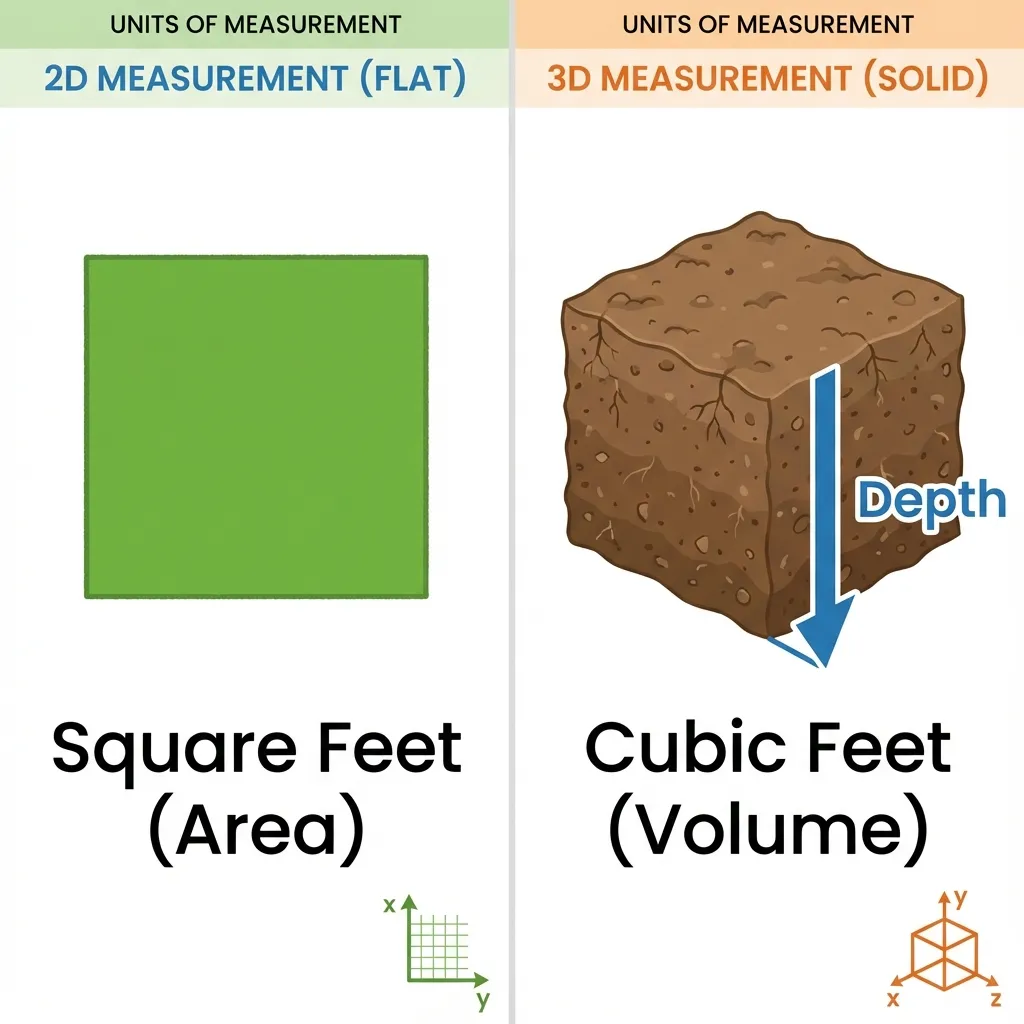
The difference is Depth: Adding the third dimension turns Area into Volume
Common Depth Conversions
- 2 inches0.167 feet
- 3 inches0.25 feet
- 4 inches0.33 feet
- 6 inches0.5 feet
- 8 inches0.67 feet
- 12 inches1.0 feet
Different Depth Scenarios
🌱 Shallow Fill (2-4 inches)
Uses: Light leveling, topdressing, garden bed preparation
Example: 400 sq ft × 0.25 ft = 100 cubic feet
⚖️ Medium Fill (4-8 inches)
Uses: Patio bases, walkway foundations, yard leveling
Example: 300 sq ft × 0.5 ft = 150 cubic feet
🏗️ Deep Fill (12+ inches)
Uses: Foundation prep, major grading, retaining wall backfill
Example: 500 sq ft × 1.5 ft = 750 cubic feet
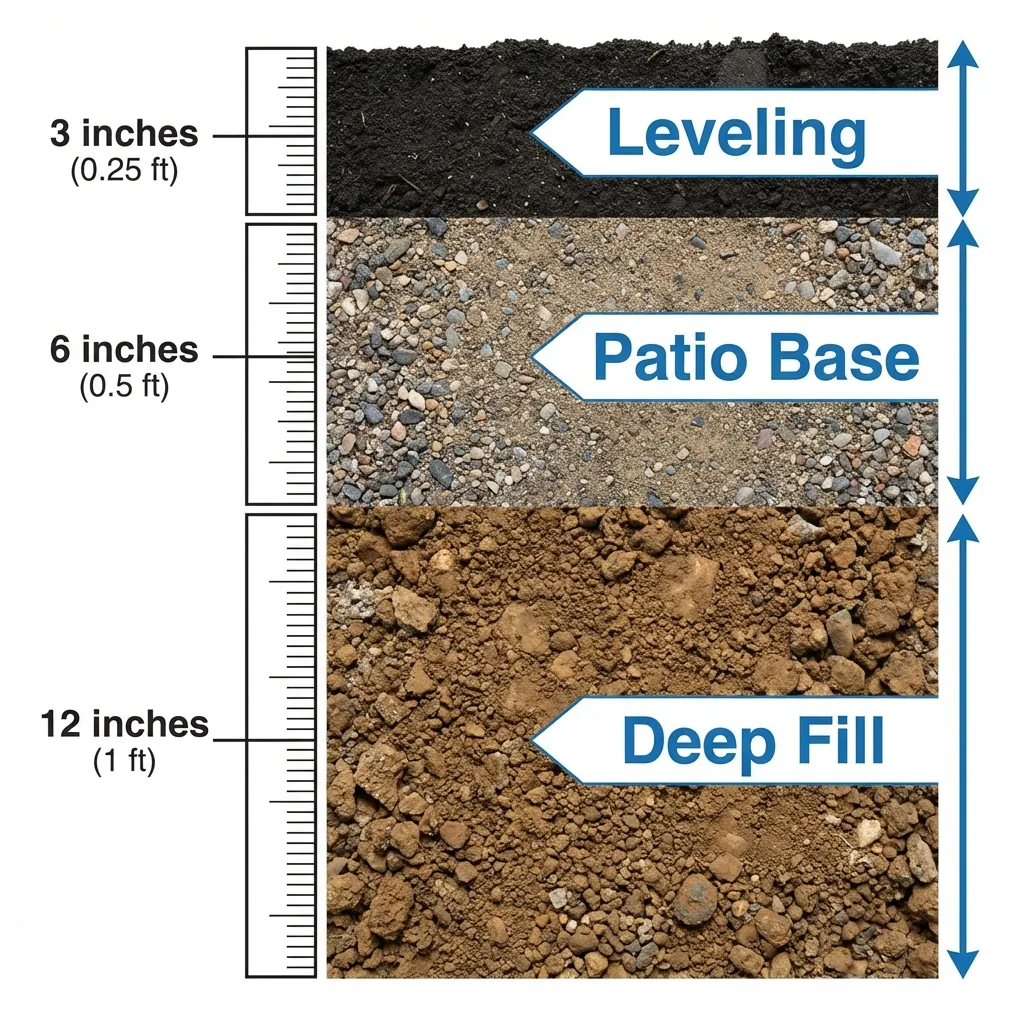
Common fill dirt depths and their applications
Step-by-Step Calculation Examples
Rectangular Patio Base
Project: 16 ft × 12 ft patio, 6-inch base layer
Step 1: 16 × 12 = 192 square feet
Step 2: 6 inches ÷ 12 = 0.5 feet
Step 3: 192 × 0.5 = 96 cubic feet
Step 4: 96 ÷ 27 = 3.56 cubic yards
Order: 4 cubic yards (with buffer)
Circular Garden Bed
Project: 10-foot diameter circle, 8 inches deep
Step 1: Radius = 10 ÷ 2 = 5 feet
Step 2: 3.14 × 5² = 78.5 square feet
Step 3: 8 inches ÷ 12 = 0.67 feet
Step 4: 78.5 × 0.67 = 52.6 cubic feet
Order: 2-2.5 cubic yards
Calculator Tools: Manual vs Online
✅ Online Calculator Benefits
- • Instant, error-free results
- • Multiple unit conversions
- • Handles different shapes
- • Automatic settling buffer
📱 When to Calculate Manually
- • On-site without internet
- • Double-checking calculator results
- • Quick rough estimates
❌ Common Square Footage Mistakes
Mistake #1: Mixing Units
Using inches for depth without converting to feet first!
❌ 200 sq ft × 6 inches = WRONG! ✅ 200 sq ft × 0.5 ft = 100 cubic feet
Mistake #2: Forgetting Compaction
Fill dirt settles 10-25%. Always add 15-20% buffer! Learn more about compaction factors.
Mistake #3: Ignoring Irregular Shapes
Break complex areas into simple rectangles/circles and add them together.
Project Examples by Square Footage
Small Projects (50-200 sq ft)
Raised Garden Bed
60 sq ft × 0.5 ft = 30 cu ft (~1.5 yards)
Small Patio Base
120 sq ft × 0.33 ft = 40 cu ft (~2 yards)
Medium Projects (200-800 sq ft)
Standard Patio
224 sq ft × 0.5 ft = 112 cu ft (~4.5 yards)
Yard Leveling
600 sq ft × 0.33 ft = 198 cu ft (~8 yards)
💰 Cost Estimation per Square Foot
Shallow Fill (3-4")
per square foot
Medium Fill (6-8")
per square foot
Deep Fill (12"+)
per square foot
🎯 Professional Tips
Insider Secrets from the Pros
- ✓Photo Document: Take pictures of your tape measure at every measurement point
- ✓The 10% Rule: Round your square footage UP by 10% before calculating
- ✓Order Timing: Schedule delivery when you have help available
- ✓Layer and Compact: For fills over 8 inches, spread in 4-inch lifts
Conclusion: You're Now a Square Footage Expert!
You now have all the knowledge you need to accurately calculate fill dirt based on square footage. Remember the key formula:
Square Feet × Depth (ft) = Cubic FeetThen divide by 27 to get Cubic Yards for ordering!
Use our free fill dirt calculator square feet tool at the top of this page for instant, accurate results. No signup required, completely free, and trusted by thousands of homeowners and contractors!
Frequently Asked Questions
How do I calculate cubic feet of fill dirt per square foot?
To calculate cubic feet per square foot, multiply your total square footage by the depth in feet. For example, 200 square feet at 6 inches (0.5 feet) deep: 200 × 0.5 = 100 cubic feet total. This means each square foot requires 0.5 cubic feet of fill dirt at that depth.
What's the difference between square feet and cubic feet for fill dirt?
Square feet measures area (length × width) - it's two-dimensional. Cubic feet measures volume (length × width × depth) - it's three-dimensional. Fill dirt is sold by volume (cubic feet or yards), so you must convert your square footage measurement by multiplying by depth.
How many cubic feet of fill dirt do I need for 500 square feet?
It depends on depth! At 3 inches: 500 × 0.25 ft = 125 cubic feet. At 6 inches: 500 × 0.5 = 250 cubic feet. At 12 inches: 500 × 1.0 = 500 cubic feet. Always convert inches to feet first by dividing by 12.
Can I use a fill dirt calculator for irregular shaped areas?
Yes! Break irregular areas into simple shapes like rectangles and circles. Calculate square footage for each section, add them together, then multiply by depth. Our calculator makes this easy by supporting multiple shape types.
How deep should fill dirt be for different projects?
Shallow leveling: 2-4 inches. Patio/walkway base: 4-6 inches. Driveway base: 6-8 inches. Foundation/structural: 12+ inches. Always add 15-20% extra for compaction regardless of depth.
What if my depth varies across the square footage?
Measure depth at 6-10 different points across the area. Add all measurements and divide by number of points to get average depth. Use this average in your calculation: Square Feet × Average Depth = Cubic Feet.
How do I convert cubic feet to cubic yards for ordering?
Divide cubic feet by 27 (since 3×3×3=27). Formula: Cubic Yards = Cubic Feet ÷ 27. Example: 135 cubic feet ÷ 27 = 5 cubic yards to order.
Is there a free fill dirt calculator square feet tool?
Yes! Our calculator at the top of this page is 100% free with no signup required. It handles square footage calculations, depth conversions, multiple shapes, and automatically converts to cubic feet, cubic yards, and tons.
How much does fill dirt cost per square foot?
Cost varies by depth: 3-4 inches: $0.30-$0.60/sq ft. 6-8 inches: $0.60-$1.20/sq ft. 12+ inches: $1.20-$2.50/sq ft. These include material and delivery. Larger projects get better rates.
Do I need to add extra for settling and compaction?
Yes! Fill dirt settles by 10-25% after placement. Always add at least 15-20% to your calculated amount. If you need 100 cubic feet, order 115-120 cubic feet to be safe.
Can I calculate in meters instead of feet?
Absolutely! Our calculator supports metric measurements. Measure in square meters and depth in centimeters or meters. The formula is the same: Area × Depth = Volume. The calculator converts automatically.
How many square feet will 10 cubic yards cover?
Convert to cubic feet first: 10 × 27 = 270 cubic feet. At 3 inches (0.25 ft): 1,080 sq ft. At 6 inches (0.5 ft): 540 sq ft. At 12 inches (1 ft): 270 sq ft. Formula: Sq Ft = Cubic Ft ÷ Depth in feet.
What's the best tool for measuring square footage?
Use a quality 50-100ft tape measure or laser measure for length and width. Document all measurements with photos. For irregular areas, use stakes and string to mark boundaries before measuring.
Should I compact fill dirt after spreading?
Yes, especially for structural projects! Use a plate compactor for areas over 50 square feet. For deep fills over 8 inches, spread and compact in 4-inch layers for better stability.
What's the difference between screened and unscreened fill dirt?
Screened fill dirt is filtered to remove rocks, roots, and debris - it's cleaner but costs $5-15 more per cubic yard. Unscreened works fine for deep layers. Pro tip: use unscreened for bottom layers, screened for top 6 inches.
