Point Load on Fill Dirt Calculator
Calculate stress distribution from concentrated loads on compacted fill. Analyze deck posts, equipment pads, and foundation points. Determine safety factors and when professional engineering is required.
By Todd Bly, B.S. Construction Management · Updated October 2026
Pro Fill Dirt Calculator
Accurate estimates for Yards, Tons, & Compaction
Results
How to Calculate Point Load on Fill Dirt
The Formula
Simplified Boussinesq equation for vertical stress beneath point load. Load in pounds, depth in feet. Compare calculated stress to fill bearing capacity and verify safety factor exceeds 2.5 minimum.
Measure Accurately
Measure in feet. For depth, measure in inches and our tool handles the conversion (divide by 12).
Check Your Shape
Most point load on fill dirt projects are rectangles. If irregular, break it into smaller shapes.
Add Compaction
Point loads create concentrated stress penetrating deep into fill and native soil. Inadequate analysis causes settlement, structural failure, and $10,000-$50,000 foundation repairs. Unlike theory-only resources, this calculator provides practical guidance for DIY screening and knowing when to hire engineers.
What Is a Point Load and Why It Matters
Point Load Definition
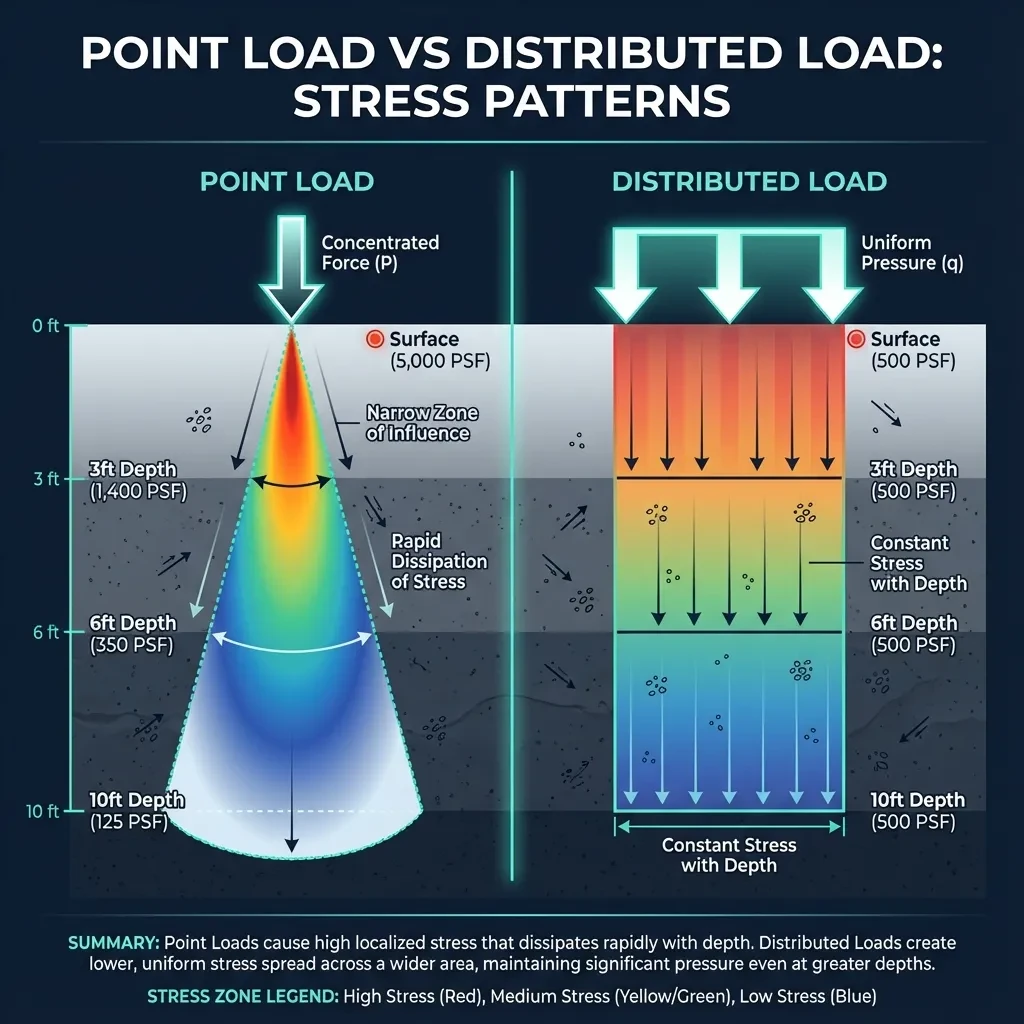
A point load represents a concentrated force acting on a small contact area, typically less than one square foot. Common examples include deck posts bearing on 6×6 bases (36 square inches), equipment supported on small feet (often 4-9 square inches), and column footings concentrating building weight onto compact areas. This concentration creates dramatically different stress patterns compared to distributed loads like concrete slabs that spread weight evenly.
Why Point Loads Challenge Fill Dirt
Compacted fill presents unique challenges for point load support. Fill compaction inevitably varies throughout depth despite best efforts—some lifts achieve 98% density while others barely reach 92%. Point load stress penetrates deep into fill and underlying native soil. At 3 feet below a point load, stress typically reduces by 70-75% but affects soil in a 6-8 foot diameter circle. Settlement risk amplifies dramatically on fills compared to natural deposits.
Understanding Stress Distribution in Fill Dirt
How Point Loads Spread Through Soil
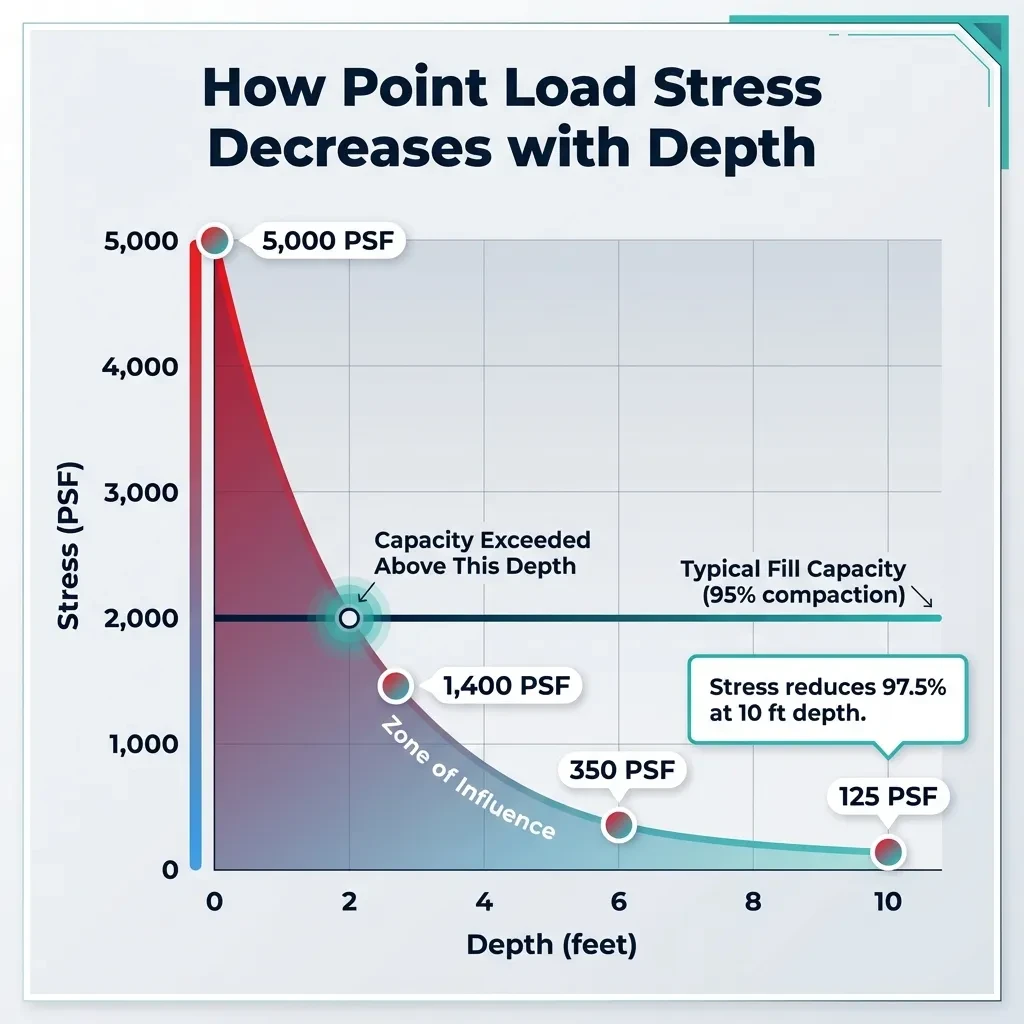
When a concentrated load presses against fill surface, 100% of that force initially concentrates on the small contact area. However, the soil mass "fans out" the load in a cone-shaped pattern, progressively distributing force across larger soil volumes as depth increases. At 3 feet below a point load, stress typically reduces to 25-30% of surface intensity but now affects a circular zone 5-7 feet in diameter.
Boussinesq's Equation (Simplified)
French mathematician Joseph Boussinesq developed stress distribution theory in 1885. The simplified formula for vertical stress directly beneath a point load is: Stress = (Load / Depth²) × Influence Factor. For most residential calculations checking stress directly below posts, using 0.48 as the influence factor provides conservative results. Example: A 5,000-pound deck post at 3 feet depth ≈ 0.48 × (5,000/9) = 267 PSF.
Bearing Capacity of Compacted Fill Dirt
Bearing Capacity by Fill Type
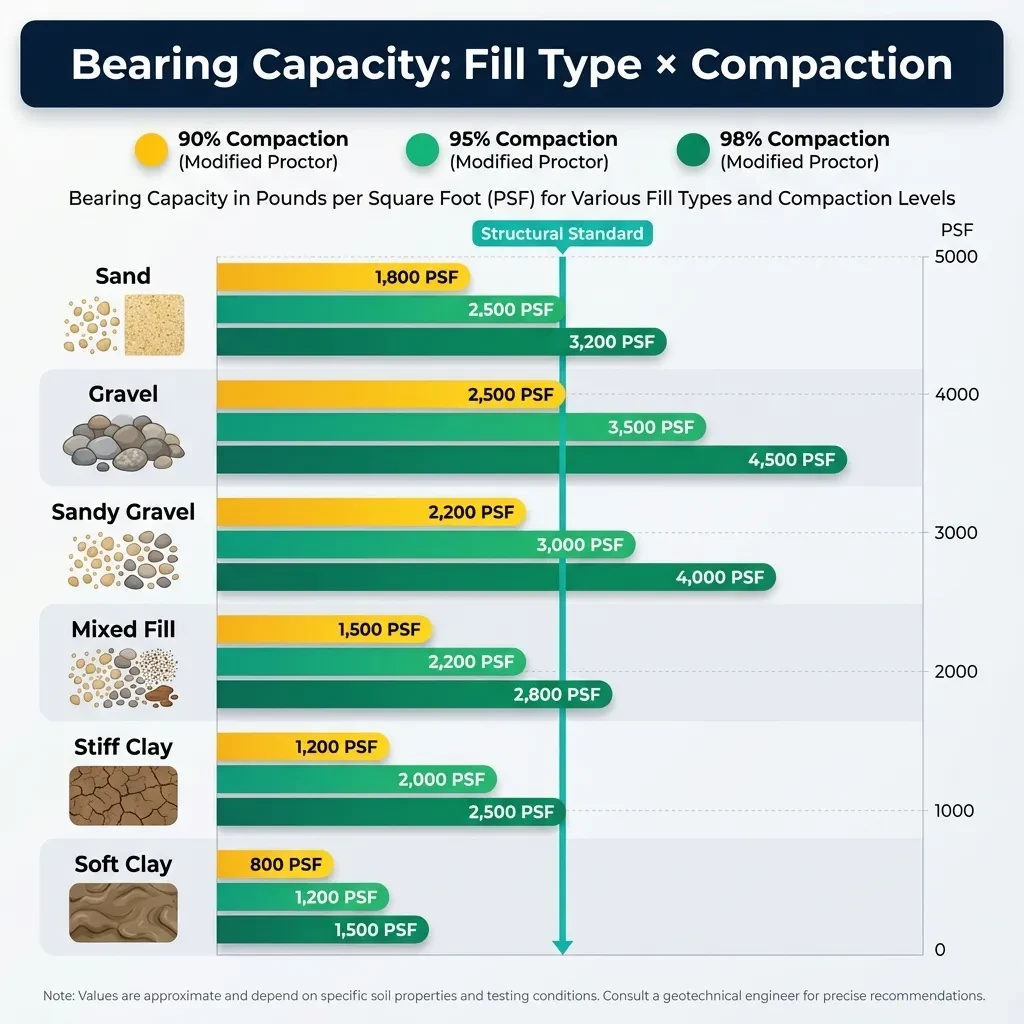
Clean sand compacted to 95% Standard Proctor typically provides 2,000-2,500 PSF allowable bearing capacity. Gravel and sandy gravel mixes achieve superior capacity: 3,000-3,500 PSF at 95%, reaching 4,000-4,500 PSF at 98%. Clay fills perform poorly: soft clays rate only 800-1,200 PSF even at 90-95% compaction. Mixed fills containing sand, silt, and clay particles together typically rate 1,500-2,200 PSF at 95% compaction.
Why Compaction Percentage Matters
The difference between 88% and 95% compaction translates to 35-45% higher bearing capacity and 60-70% less settlement. Spending $75-150 per compaction test prevents $5,000-20,000 foundation repair bills from settlement or failure. Achieving 98% compaction costs only 10-15% more than 95% but delivers 20-30% more capacity.
Common Residential Point Loads
Typical Applications
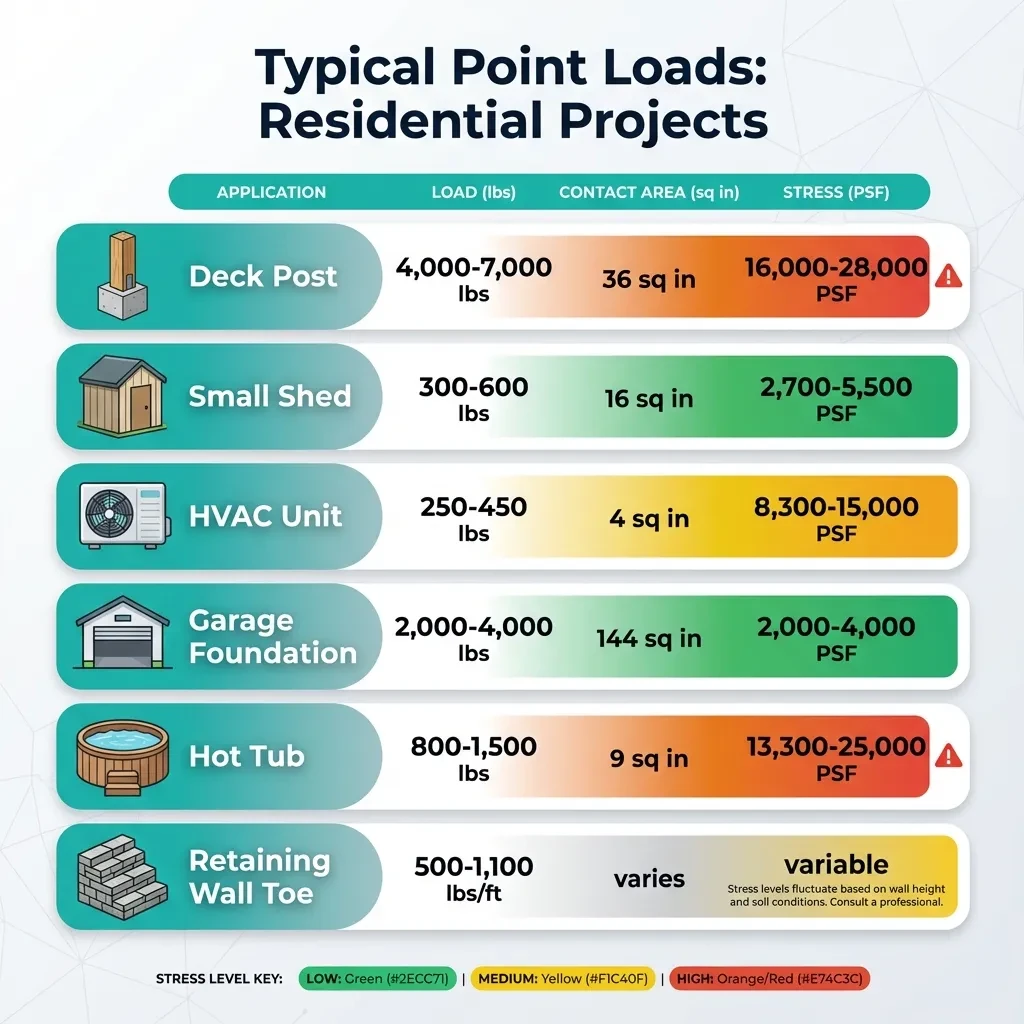
Deck Posts: 4,000-7,000 lbs typical (creates 16,000-28,000 PSF surface stress on 6×6 post). Small Sheds: 300-600 lbs per corner post. Equipment Pads (HVAC): 250-450 lbs creating 8,000-15,000 PSF on small feet. Garage Foundation: 2,000-4,000 lbs at corners. Hot Tub Supports: 800-1,500 lbs per support point creating 13,000-25,000 PSF.
Safety Factor Requirements
Safety Factor (SF) = Allowable Bearing Capacity ÷ Applied Stress at depth. Minimum accepted safety factors: 2.5 for residential structures, 3.0 for settlement-sensitive applications, 3.5-4.0 for fills with limited testing or hot tubs. Safety factors below 2.5 require design modifications—larger footings, improved compaction, or professional engineering.
Recommended Safety Factors
- Residential decks/sheds: Minimum 2.5, Recommended 3.0-3.5
- Equipment pads (static): Minimum 2.5, Recommended 3.0
- Hot tubs/pools: Minimum 3.0, Recommended 3.5-4.0
- Garage/workshop floors: Minimum 2.5, Recommended 3.0
- Commercial structures: Minimum 3.0, Recommended 4.0+
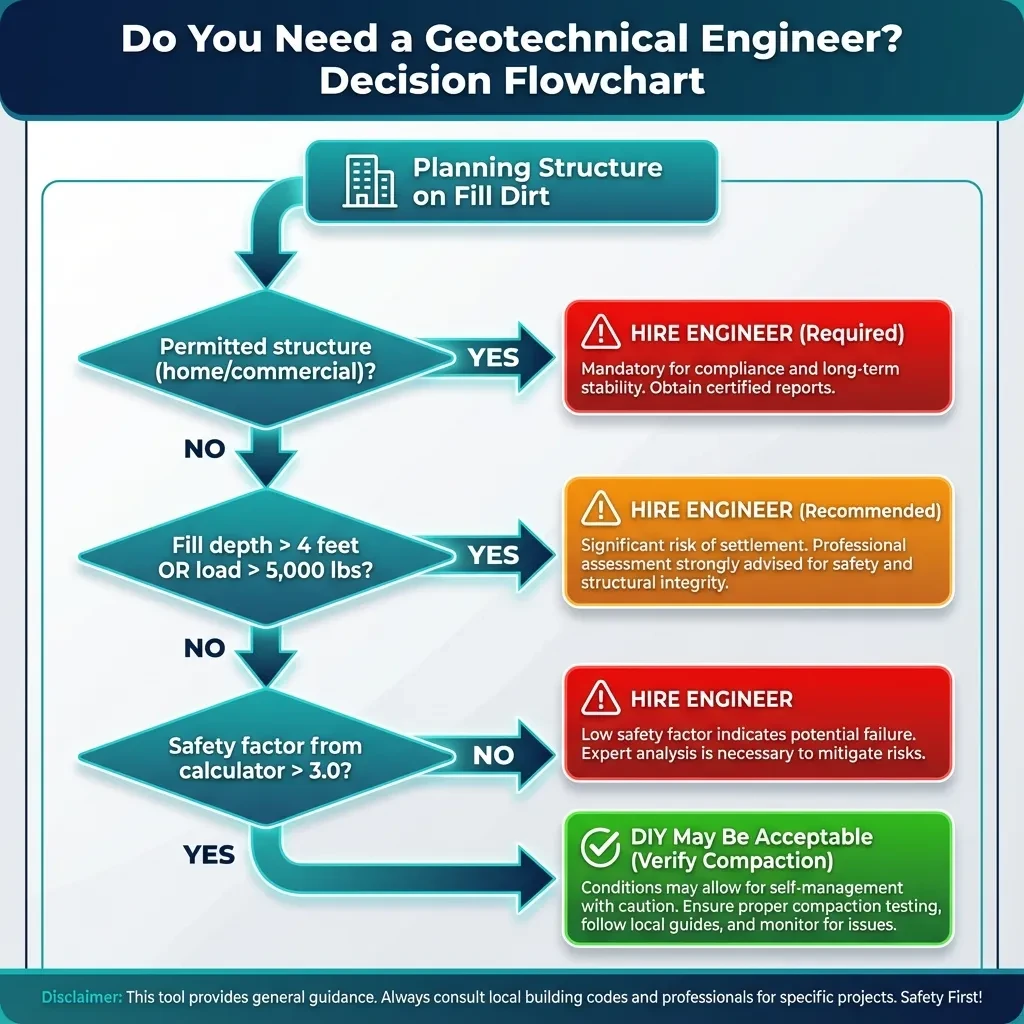
When to Hire a Geotechnical Engineer
DIY-Safe Scenarios
Small sheds on less than 2 feet fill (under 200 sq ft footprint), deck posts on verified 95%+ compacted fill under 3 feet deep, equipment pads (HVAC, generators) on thin fill, calculated safety factor exceeding 3.5, and no settlement-sensitive adjacent structures.
Engineering Required
Residential home foundations on any fill, commercial buildings, fill depth over 6 feet for any structure, retaining walls over 4 feet height, poor native soil below fill (soft clay, peat), any project requiring building permit, safety factor under 2.5 from calculator, adjacent structures within 1.5× fill depth.
Typical Engineering Costs
- Basic soils report (residential): $1,500-$3,500
- Comprehensive geotechnical investigation: $3,000-$8,000
- Plate load testing: $500-$1,200 per test
- Compaction testing (per test): $75-$150
- Engineer consultation (hourly): $150-$300/hour
Compaction Requirements for Point Load Support
Minimum Standards
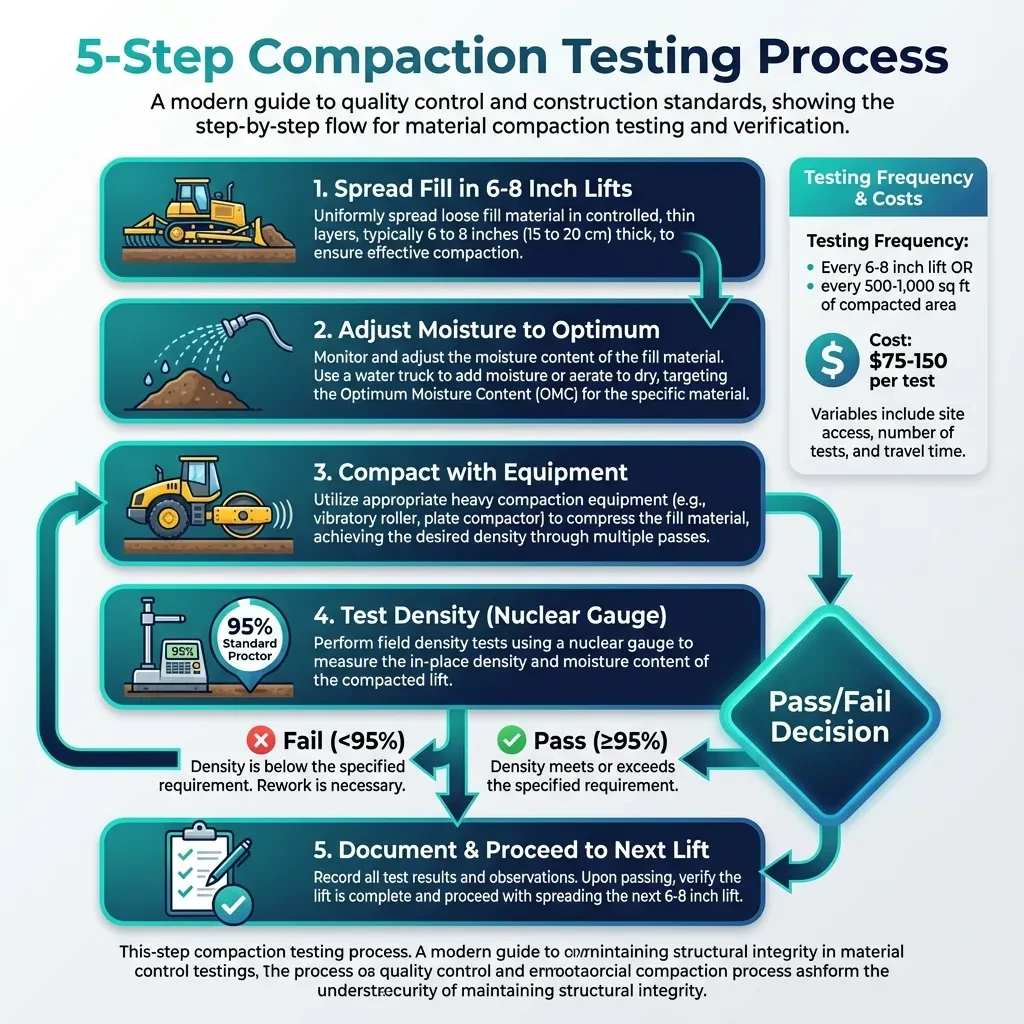
Minimum 95% Standard Proctor compaction required for structural fills supporting point loads. This balances achievable field performance against engineering requirements. Critical applications benefit from 98% compaction, which delivers 20-30% more capacity and 50-70% less settlement than 95%. Below 90% compaction, fills become unpredictable with high settlement risk.
Testing Frequency
Test every 6-8 inch lift OR every 500-1,000 square feet, whichever occurs more often. A 1,000 square foot area filled 3 feet deep requires 4-8 tests minimum. Per-test cost: $75-$150. Compare to repair costs if settlement occurs: $5,000-$20,000+.
Common Mistakes
Ignoring Fill Depth
Must check stress through entire fill to native soil below
Assuming All Fill Is Equal
Sandy fill (3,000 PSF) vs clay (1,500 PSF) = 2× difference
Skipping Compaction Verification
Visual inspection cannot detect 85% vs 95% compaction
Using Bearing Capacity Alone
Settlement still occurs even with adequate bearing
Ignoring Native Soil Below
Weak native soil limits capacity regardless of good fill
Not Accounting for Multiple Loads
Adjacent posts create overlapping stress zones
DIY on Deep or Critical Fills
Calculators are screening tools, not engineering design
Trusting Old Fill Without Testing
Unknown compaction, possible settlement already occurred
Explore More Calculators
Planning additional fill dirt projects? FillDirtCalculator offers specialized calculators for every application:
- Fill Dirt Calculator (Homepage) - General purpose cubic yard calculator
- All Calculators - Browse our complete collection
- House Pad Fill Dirt Calculator - Building pad preparation
- Compacted Fill Dirt Calculator - General compacted fill
Frequently Asked Questions
What is the difference between a point load and a distributed load on fill dirt?
A point load concentrates force on a small area (typically under 1 square foot), such as a post, column, or equipment foot, creating high surface stress that penetrates deep into soil in a cone pattern. Distributed loads spread weight evenly across large areas like slabs or continuous footings, creating lower, more uniform stress. Point loads require deeper stress analysis because they affect soil zones 5-10+ feet in diameter at moderate depths.
How deep does stress from a point load penetrate into compacted fill?
Point load stress penetrates approximately 1.5-2.0 times the depth for significant influence. Stress typically reduces to 25-30% of surface stress at 3 feet, 7-10% at 6 feet, and 2-3% at 10 feet. For fills over native soil, you must calculate stress through entire fill depth plus 1-2 times fill thickness into underlying native material.
What compaction percentage is required for fill dirt to support point loads safely?
Minimum 95% Standard Proctor density required for structural fills supporting point loads. This balances field achievability against engineering performance. Critical or heavy loads benefit from 98% compaction. Below 90% compaction, fills become unpredictable with high settlement risk.
How do I calculate the safety factor for a point load on fill dirt?
Safety Factor equals Allowable Bearing Capacity divided by Applied Stress at depth. Calculate stress using Boussinesq methods, look up allowable capacity for fill type and compaction, then divide. Minimum SF = 2.5 for residential, preferably 3.0-3.5.
Do I need a geotechnical engineer for a deck built on compacted fill?
For small decks under 200 sq ft on shallow verified 95%+ fill with SF over 3.5, DIY may be acceptable. Engineering recommended for decks over 300 sq ft, fills deeper than 4 feet, hot tubs, unknown compaction, poor native soil, or when permits required. Cost $1,500-3,000 prevents $5,000-15,000 settlement damage.
What is Boussinesq's equation and why does it matter for fill dirt?
Boussinesq's equation calculates vertical stress at any point in soil beneath a surface point load. Developed in 1885, it predicts how concentrated surface stress dissipates with depth, enabling verification that stress at critical depths remains within safe capacity limits.
How much does testing compacted fill cost and is it really necessary?
Compaction testing costs $75-150 per test. Typical project requires 3-8 tests ($300-900 total). Testing is absolutely necessary because visual inspection cannot distinguish 85% from 96% compaction, yet this affects capacity by 30-40% and settlement by 60-80%.
Can old fill dirt that's been in place for years support point loads?
Possibly, but never assume—always test before relying on existing fill. Unknowns create risk: original compaction unclear, material composition uncertain, previous loading might have caused settlement. Test at proposed load locations and verify both fill and underlying soil capacity.
What happens if the native soil below my fill is weak?
Point load stress penetrates through fill into native soil. If native capacity falls below applied stress, failure occurs at the weak layer regardless of excellent fill above. Solutions include removing weak soil, deep foundations extending to competent bearing, or reducing loads through larger footings.
How do multiple point loads near each other affect stress in fill dirt?
Multiple loads spaced closer than 2-3 times depth create overlapping stress zones with combined peaks 20-45% higher than individual calculations. Use conservative combined loading assumptions or geotechnical software for closely-spaced loads.
Is settlement or bearing capacity more important for structures on fill?
Both matter equally, but settlement often governs design. Fills might safely carry loads without shear failure while settling 1-2 inches, damaging structures. Professional engineers evaluate both simultaneously, ensuring designs prevent failure AND limit settlement.
What's the maximum fill depth I can use without engineering for a residential project?
For permitted structures, engineering legally required regardless of depth. For non-permitted minor structures, depths under 3 feet with verified 95%+ compaction and SF over 3.5 may be DIY-suitable. Beyond 4 feet, professional analysis mandatory.
How does moisture content in fill dirt affect its load-bearing capacity?
Each soil has optimum moisture content (8-15% for sand, 12-20% for clay) where compaction achieves maximum density. Too dry or wet prevents proper compaction. After placement, saturated fills lose 10-25% capacity. Drainage prevents saturation and preserves capacity.
Can I build a garage or shed on fill dirt without removing it?
Yes, if fill is structural-grade, compacted to 95%+ with testing, uniform thickness, and adequate capacity. Sheds under 200 sq ft on 2-3 feet tested fill may proceed with calculator verification. Garages need engineering. Removal necessary if fill contains organics, compaction unknown, depth exceeds 6 feet, or native soil very soft.
Can I use the same bearing capacity for fill dirt as natural soil?
No—bearing capacity varies dramatically. Well-compacted gravel fill achieves 3,000-3,500 PSF, exceeding natural clay at 1,500-2,500 PSF. Poor fill below 90% might rate only 800-1,500 PSF. Compacted fill also exhibits 2-4 times more settlement than natural soil despite higher bearing.